
Nikon Cameras
Nikon ZR Review
RED Digital Cinema, a pioneer in high-end digital cinema cameras, has long been renowned for producing professional cameras capable of delivering stunning image quality for film and television. In 2024, Nikon acquired RED Digital Cinema, allowing the company to expand into the professional digital cinema market and leverage RED’s expertise in cinema cameras.
Nikon ZR represents the first collaboration between the two companies, combining the strengths of both brands into a unique product. The ZR features the same 24 MP partially stacked sensor and EXPEED 7 processor found in the Z6 III but removes the mechanical shutter and electronic viewfinder, packing everything into a small, lightweight and portable body with a simple, video-focused design. This makes the ZR a highly accessible option for filmmakers and content creators seeking professional-quality in a compact form.
Nikon Z System
Nikon ZR continues Nikon’s commitment to the Z-mount system, which debuted in 2018 with the original Z6 and Z7. With a larger mount diameter and shorter flange distance, the Z system allowed Nikon to design faster, sharper lenses with better low-light performance. Compared to old DSLRs the system is smaller and lighter while also improving autofocus speed and overall image quality. After nearly a decade, the Z-mount system now provides a wide selection of lenses. Nikon F-mount lenses (older DSLR lenses) remain fully compatible with Nikon Z cameras via the FTZ adapter.
Nikon ZR Price
Nikon ZR Specifications
General
Nikon ZR features a 24.5 MP partially stacked BSI sensor paired with Nikon’s EXPEED 7 processor. The same sensor and processor were already used in the Nikon Z6 III.
In-body 5-axis image stabilization provides up to approximately 7.5 stops of shake reduction in testing. There are two stabilization modes available in the settings menu, with “Sport” mode producing more stable results.
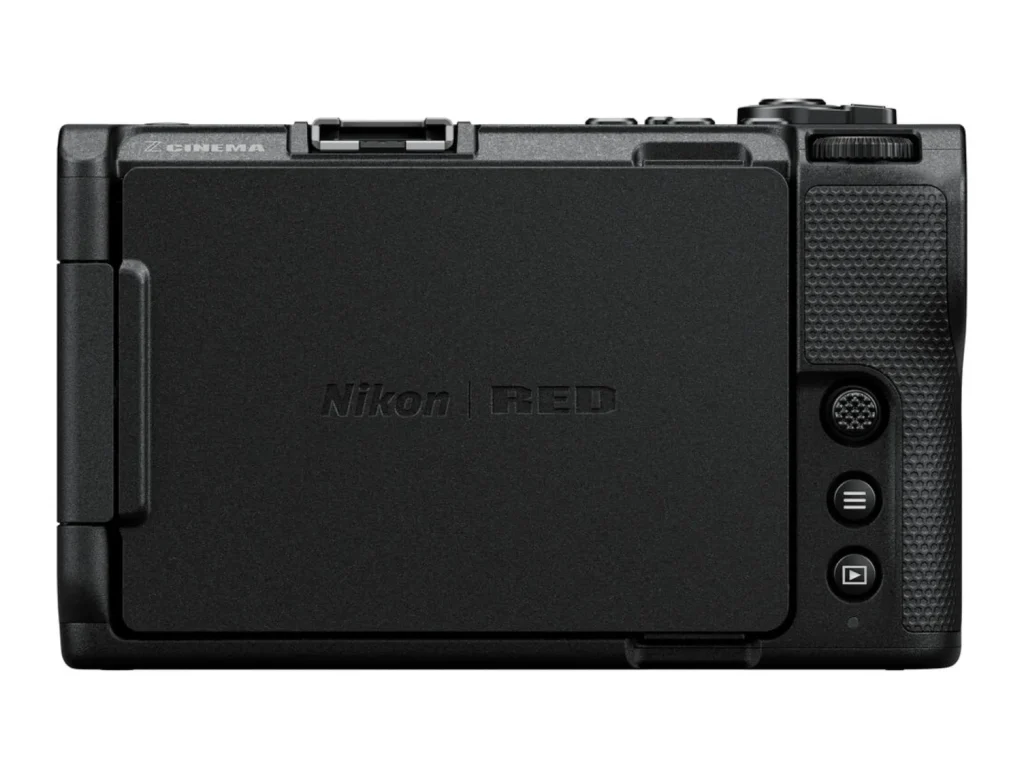
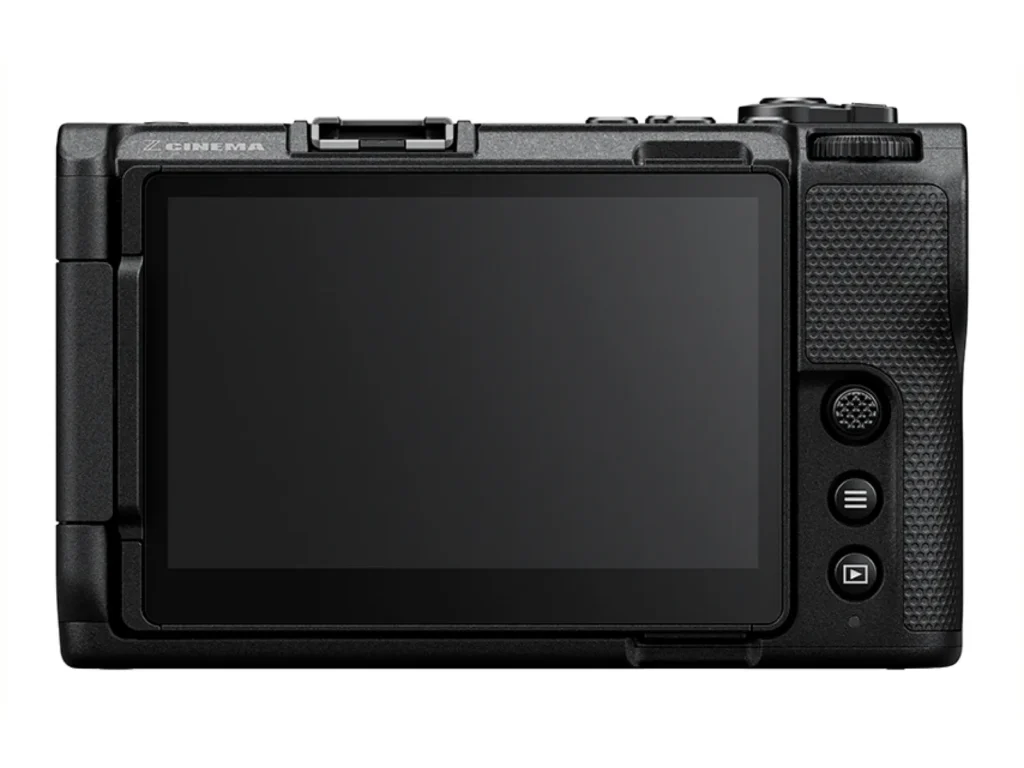
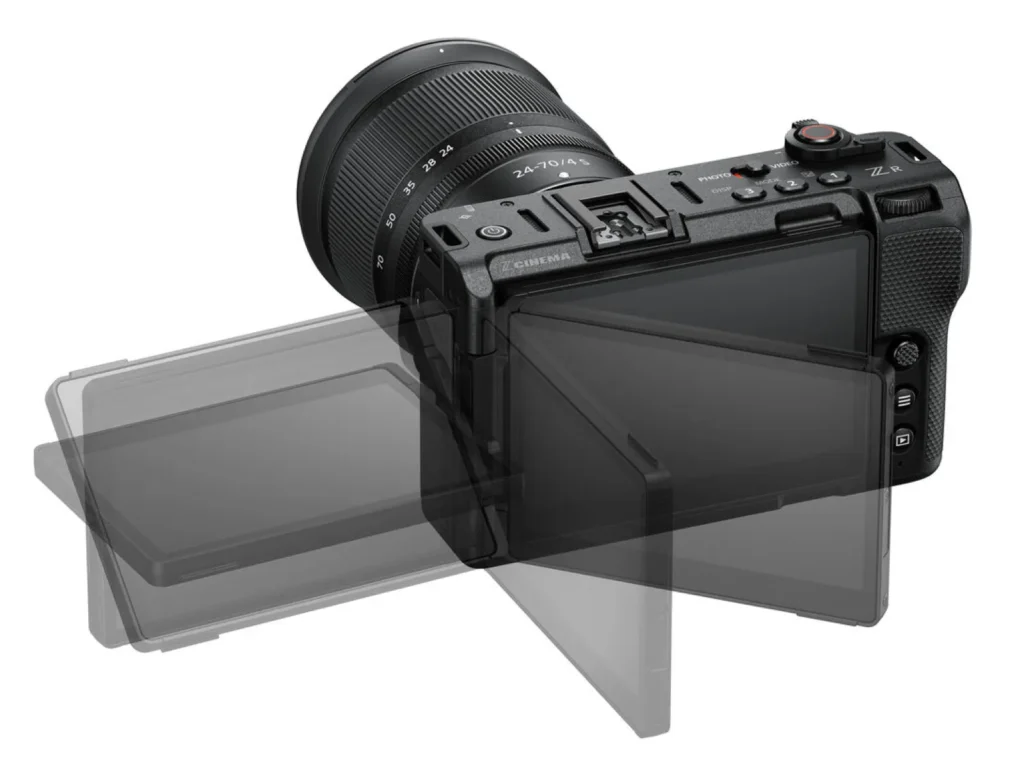
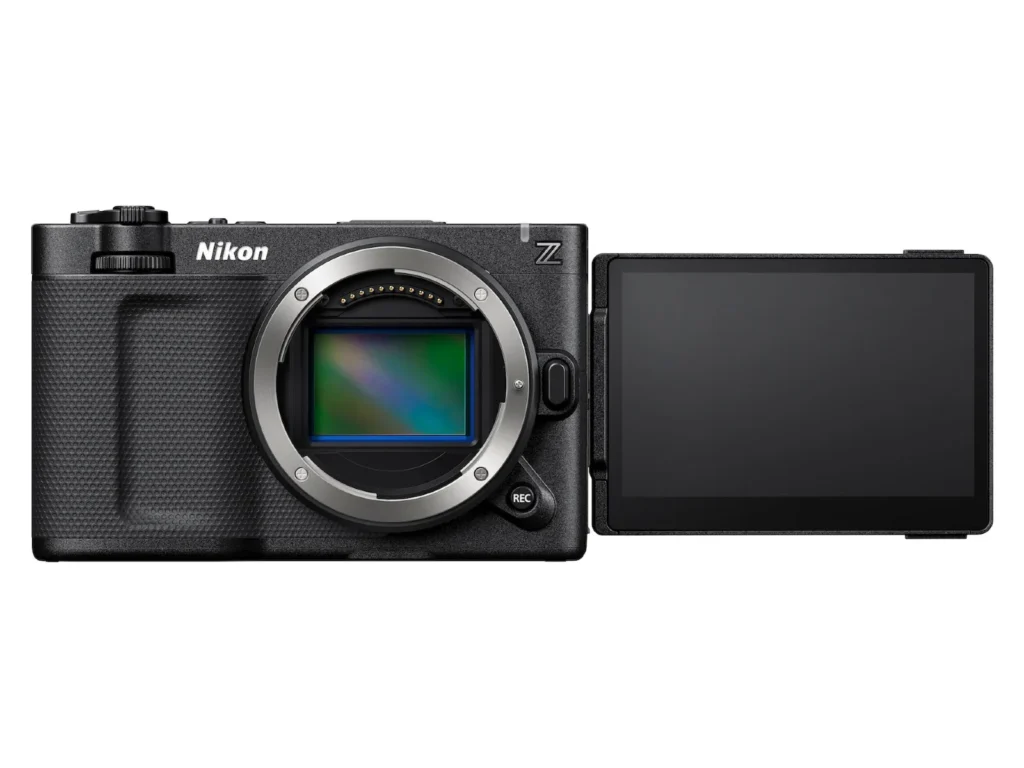
The ZR features a fully articulating LCD screen. It’s very bright, by far the largest in the entire Nikon lineup and one of the largest screens in the camera industry. A screen this large is extremely practical for video monitoring.
The camera has dual card slots – one XQD or CFexpress and one microSD. Video recording can only be saved to a single card (as with all other Nikon cameras) and in this case it defaults to the faster, durable CFexpress card. The smaller microSD card is generally intended for occasional photos. Keep in mind that the compartment cannot be fully opened when the camera is mounted on a tripod and removing the microSD card requires removing the battery.
Body Design
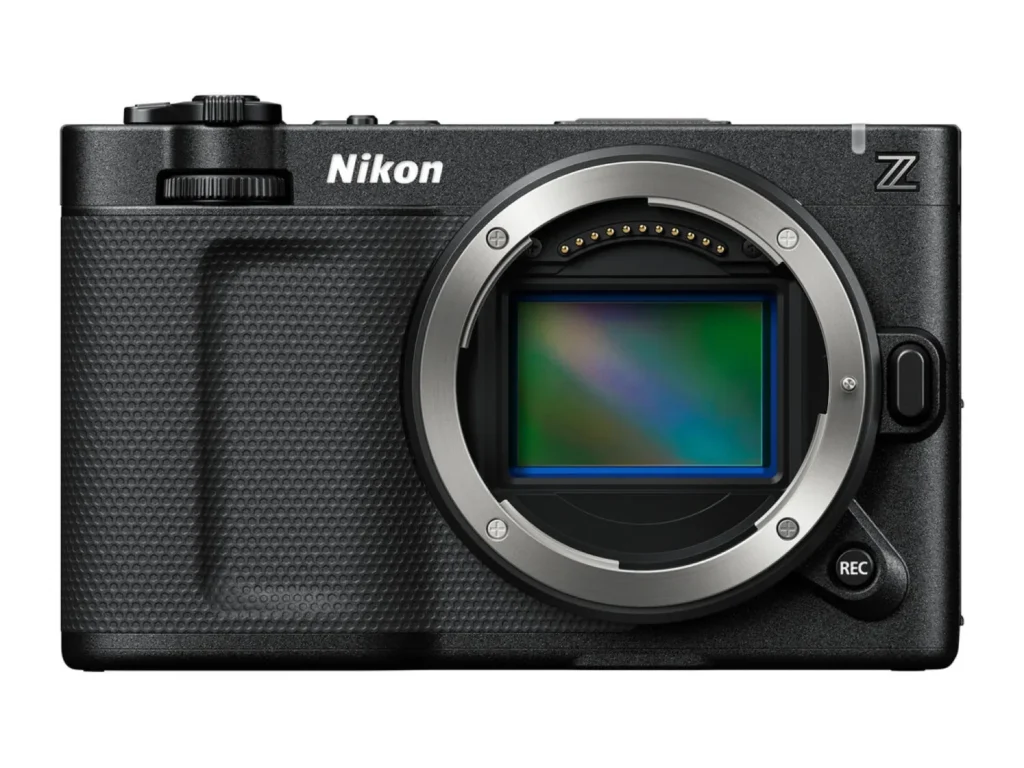
Nikon ZR is the smallest full-frame camera in Nikon’s lineup. It’s less ergonomic than the Z6 series, but still quite comfortable to hold. The body is also weather-sealed, though not to the same degree as Nikon’s high-end models (weather resistent).
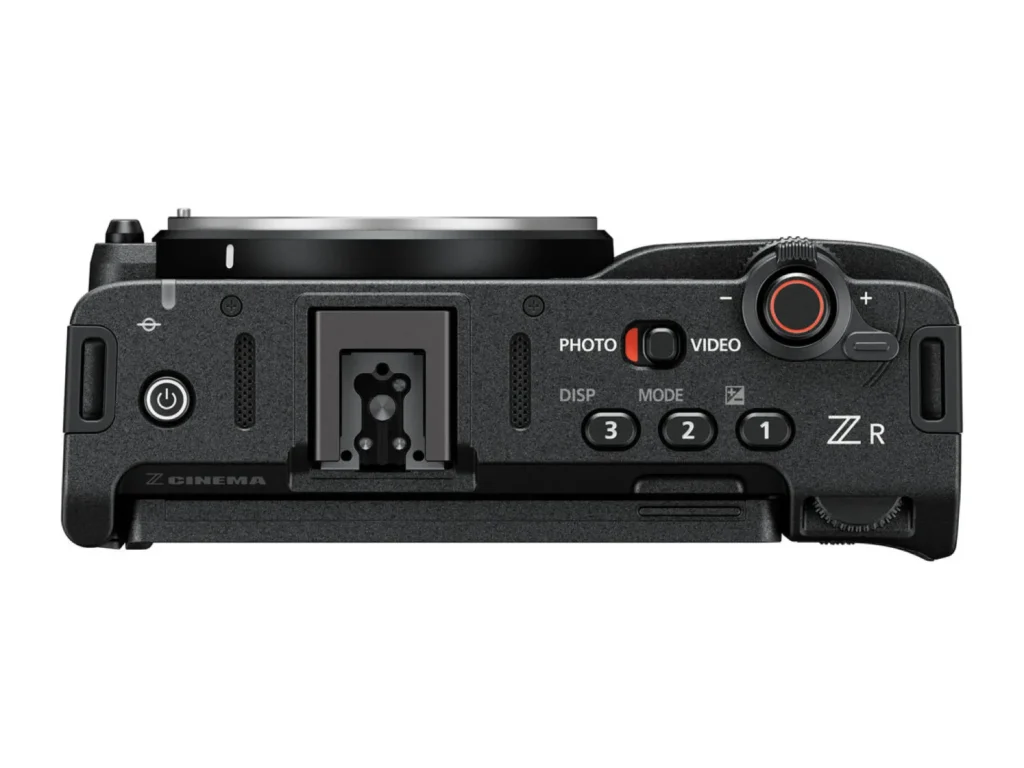
The ZR is marketed as a video-first camera, meaning you may want to attach additional videography gear, but a cage is required since the ZR only has a digital hot shoe on the top and a single standard mounting point on the bottom. Notably, this marks the first time Nikon added a digital hot shoe to a mirrorless camera that enables 32-bit float audio recording.
Button layout is very minimalistic: on top, there are three custom buttons, a video/photo switch and a record button with a zoom rocker; on the back, there are just two buttons and a small AF joystick. It’s positioned differently than on other Nikon models, which some users may find awkward or harder to control.
The menu is accessed by holding the ‘hamburger button’ on the back of the camera. The interface and menu options change depending on whether the camera is set to photo or video mode.
To maintain a small, compact design and keep costs down, the ZR does not have a built-in fan like some dedicated cinema cameras.
Autofocus
Autofocus performance is exactly the same as that of the Z6 III. Thanks to deep-learning-based subject recognition and improved phase-detect algorithms, the camera reliably tracks human and animal subjects and maintains focus even in extremely low-light conditions.
The ZR features up to 299 points in photo mode and 253 points in video mode. 3D tracking and wide-area AF modes give users flexibility when shooting unpredictable subjects like for example wildlife or sports.
In real-world use, autofocus performance varies depending on the lens and settings. Most reviewers note that it still doesn’t reach the level of competitors from brands such as Canon and Sony.
Photography
The ZR is not designed for photography – it lacks an EVF, has no mechanical shutter and the shutter button behaves differently than on other Nikon cameras, making it poorly suited for traditional still shooting.
That said, most of the underlying photography features are the same as on the Z6 III. Image quality is excellent, with good dynamic range, natural color rendering and very clean performance at high ISO settings.
The ZR can shoot at up to 20 fps in 14-bit RAW, up to 60 fps in JPEG or up to 120 fps with a 1.5x crop and at a reduced 11 MP resolution.
Buffer limitations are effectively a non-issue, with capacities ranging from roughly 300 frames to well over 1,000 frames depending on the shooting mode.
Pre-Capture mode can record approximately 1 second of images before the shutter is fully pressed at up to 120 fps, but this feature is limited to JPEGs.
Nikon ZR also includes a sensor-shift mechanism that enables pixel-shift shooting, combining multiple exposures with slight sensor movements to produce high-resolution images of up to 96 MP. This technique is ideal for static subjects, but it requires the use of Nikon’s NX Studio software to merge the images into a single high-resolution file.
| Feature | NIKON ZR |
|---|---|
| Release Date | October 2025 |
| Megapixels | 24.5 MP |
| Image Resolution | 6048 × 4032 |
| Sensor Size | Full Frame |
| Sensor Type | Partially Stacked CMOS |
| Image Processor | EXPEED 7 |
| IBIS | 5-Axis, 7.5 stops |
| Weather Sealing | Yes |
| Lens Mount | Nikon Z |
| Body Type | Mirrorless |
| PHOTO | |
| Native ISO | 100 – 51,200 |
| Expandable ISO | 50 – 204,800 |
| Shutter Speed | 1/16000 – 900s |
| Burst Rate (Mechanical) | / |
| Burst Rate (Electronic) | 20 fps RAW / up to 120 fps JPEG |
| Buffer | 300 ~ 1000 RAW |
| Shutter Types | Electronic |
| Silent Shooting | Yes (Electronic Shutter) |
| Exposure Compensation | ±5 EV |
| High-Res (Sensor Shift) | Yes |
| Pre-Capture Mode | Yes (JPEG) |
| VIDEO | |
| 4K Video | 4K 60fps (oversampled from 6K) |
| Max Frame Rate | 6K 60fps / 4K 120fps (1.5x crop) / 1080p 240fps |
| Bit Depth | 12-bit |
| Recording Limit | 125 min |
| Timelapse Recording | Yes |
| AUTOFOCUS | |
| AF System | Hybrid AF + AI-based deep-learning engine for enhanced subject recognition and tracking |
| AF Points | 299 |
| AF Coverage | ~ 90% Frame Coverage |
| AF Joystick | Yes |
| DISPLAY / VIEWFINDER | |
| Articulated Screen | Fully Articulating |
| Touch Screen | Yes |
| LCD Size | 4" |
| LCD Resolution | 3,070,000 |
| EVF Resolution | / |
| EVF Refresh Rate | / |
| EVF Coverage | / |
| EVF Magnification | / |
| MORE INFO | |
| Card Slot 1 | XQD / CFexpress Type B |
| Card Slot 2 | microSD (UHS-I) |
| Sensor Protection System | No |
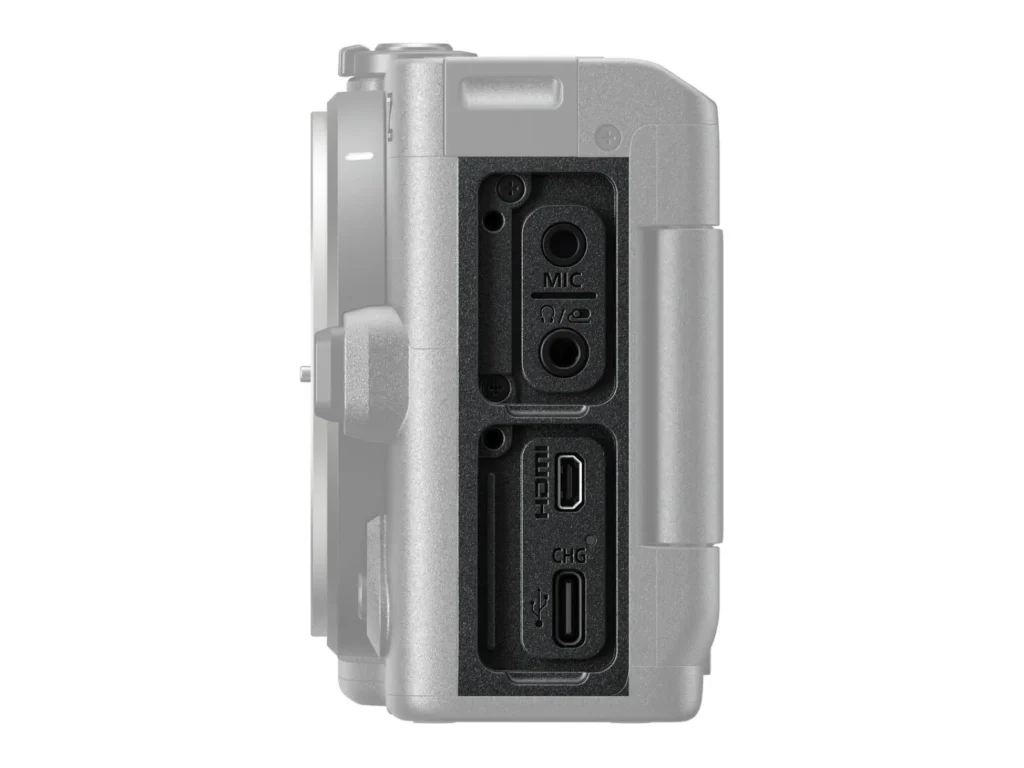
| USB | Type C 3.2 Gen 1 |
| USB Charging | Yes |
| HDMI | Type D (Micro HDMI) |
| Microphone Port | 3.5 mm |
| Headphone Port | 3.5 mm |
| Built-in Flash | No |
| Built-in Microphone | Yes |
| Battery | EN-EL15c |
| Battery Life | 350 ~ 500 frames |
| Wi-Fi / Bluetooth | Yes |
| Dimensions | 134 × 81 × 49 mm |
| Weight | 630 g |
Video
Video is the ZR’s main strength. It is the smallest camera capable of RED RAW recording (12-bit R3D NE). RED RAW is an extremely high-quality codec, borrowed from professional RED cinema cameras.
The ZR can record 6K 60 fps internally, but this mode is limited to 12-bit RED RAW and 12-bit N-RAW. N-RAW is Nikon’s extremely high-quality codec, preserving maximum detail, dynamic range and color information. In the past, N-RAW footage could only be edited in DaVinci Resolve. While support has since expanded to some other video editors, compatibility is still not universal, so it’s important to confirm that N-RAW fits into your editing workflow.
6K 30 fps and other recording modes, allow the use of ProRes RAW, which delivers image quality almost as high as N-RAW.
In terms of 4K video, the Z6 III can record oversampled 4K at 60 fps without a crop, resulting in excellent image quality. It can also record 4K at 100 fps and 120 fps, though these modes are cropped and not oversampled, leading to reduced sharpness.
For extreme slow motion, the camera offers Full HD (1080p) recording up to 240 fps.
The ZR has a maximum clip length of 125 minutes. Having a recording limit on a camera marketed as a “cinema camera” seems counterintuitive.
The camera only records video to a single card (the CFexpress card) which reduces redundancy and is a downside for professional work where backup recording is critical. This limitation applies to all Nikon cameras.
Using the USB-C port, the camera can also be used for 1080p streaming at up to 60 fps.
Lower-Quality Recording Options for Social Media and Smaller File Sizes
Using high-quality codecs results in extremely large file sizes, which should be factored into storage and workflow considerations. For users who want to avoid massive file sizes – or who don’t require high-quality N-RAW or RED RAW video – the ZR offers several alternative recording options.
The 10-bit ProRes 422 HQ codec still produces detailed, good-looking footage while being much smaller in terms of file size. For creators, vloggers, and those producing content for social media or YouTube, Nikon’s 10-bit H.265 recording options may be the most practical choice. However, for footage intended for large displays or heavy post-production, H.265 is not recommended due to aggressive noise reduction that noticeably reduces overall image quality compared to higher-quality modes.
Nikon ZR Alternatives
Nikon Z6 III
Nikon Z5 II
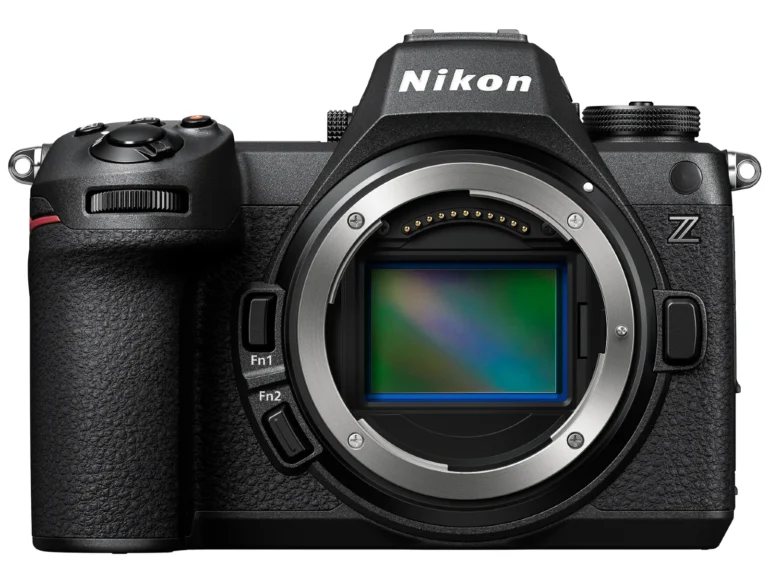
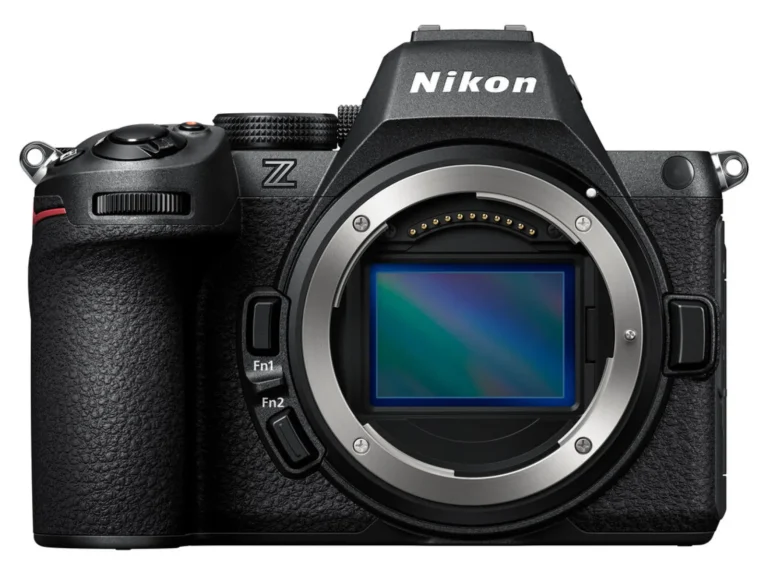
Nikon Z6 III (2024) offers all the same specs as the Nikon ZR. It has the same 24 MP partially stacked sensor, the same EXPEED 7 processor, the same reliable autofocus system and all the video recording formats including internal 6K 60 fps 12-bit N-RAW recording. It has a standard modern mirrorless body with an EVF and with IBIS, making it amazing for both photography and videography. It is Nikon’s most advanced 24 MP camera and a more practical choice for most users than the ZR. The only real advantage the ZR has over the Z6 III is the RED RAW recording option.
Nikon Z5 II (2025) – is Nikon’s entry-level full-frame camera in case you are looking for a more affordable entry point into Nikon’s full-frame mirrorless system. It uses a 24 MP BSI sensor (instead of a faster partially-stacked sensor) paired with Nikon’s EXPEED 7 processor. It doesn’t offer advanced video recording formats of the Z6 III or the ZR, bit it still offers oversampled 4K 30 fps 12-bit N-RAW recording and 4K 60 fps recording with a 1.5x crop. It can shoot at up to 11 fps in RAW with the mechanical shutter (14 fps JPEG), up to 14 fps RAW with the electronic shutter (30 fs JPEG).
As of now, the Z5 II is likely the best affordable entry point into Nikon’s full-frame Z system for anyone interested in photography or video.
Sony A7 V
Sony A7 IV
Sony A7 III
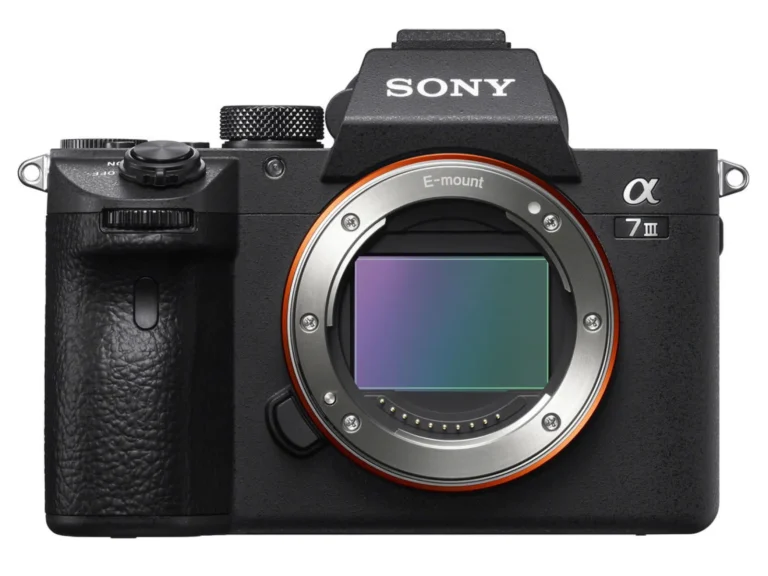
Sony A7 III (2018) is Sony’s entry-level full-frame camera. It’s a competitor to the Z6 II or Z5 II and uses a similar 24 MP BSI sensor along with IBIS, dual card slots, weather sealing and continuous shooting up to 10. The Z6 II and the Z5 II exceed it in build quality and color science while the A7 III is typically cheaper when purchased used, since it’s more popular and has been around for longer.
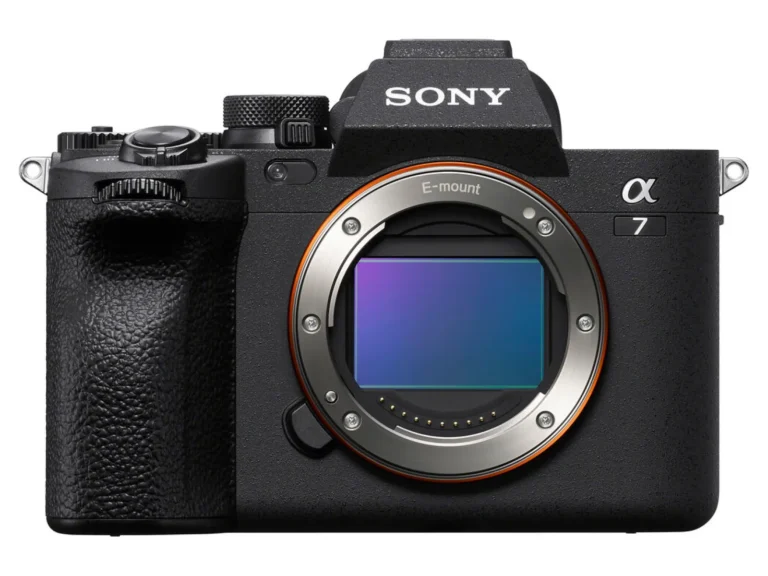
Sony A7 IV (2021) marked a major step forward in Sony’s full-frame lineup. It features a newer 33 MP BSI sensor and advanced autofocus along with strong video capabilities including 4K at 60 fps recording (with very noticeable rolling shutter distortion). In terms of image quality, it produces excellent stills with excellent dynamic range. However, the continuous shooting is limited to just 6 fps RAW or 10 fps compressed RAW (versus 20 fps RAW with the ZR) and when using the electronic shutter, rolling shutter distortion is extremely visible due to the high-resolution sensor with slower readout speed. Additionally the price is also higher than the ZR or the Z6 III.
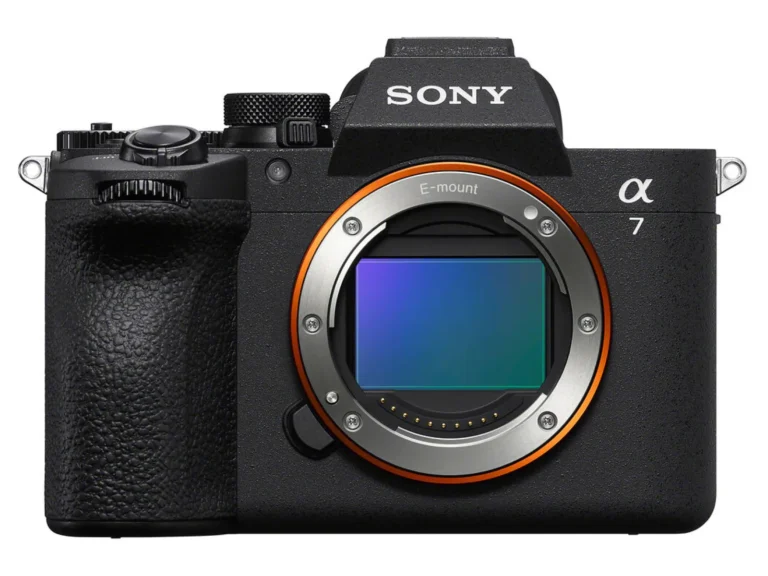
Sony A7 V (2025) replaces the classic 33 MP BSI sensor with a faster partially-stacked 33 MP BSI sensor with faster readout resulting in even better autofocus performance, much less rolling shutter distortion and better high-speed shooting performance (up to 20 fps with the electronic shutter and up to 30 fps with Sony-branded lenses). It also introduces a new BIONZ XR2 processor with a built-in AI processing unit and a new hybrid screen design (tilting and fully articulating). Video recording is limited to 4K and to 10-bit (there is no internal or external 12-bit RAW recording option).
Sony A7 V currently represents great value, especially compared to the Sony A7 IV, but it’s significantly more expensive than the Nikon ZR or the Z6 III. Pricing in this segment fluctuates over time, but it currently costs about $800 more.
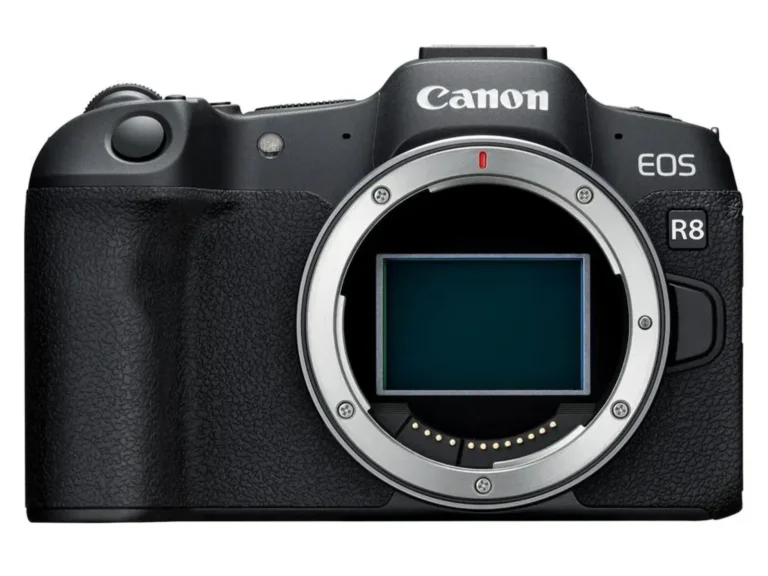
Canon R8
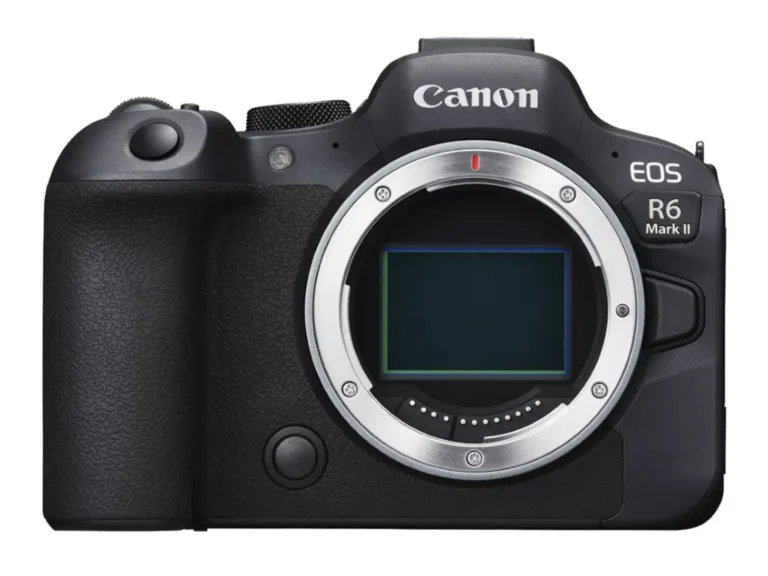
Canon R6 II
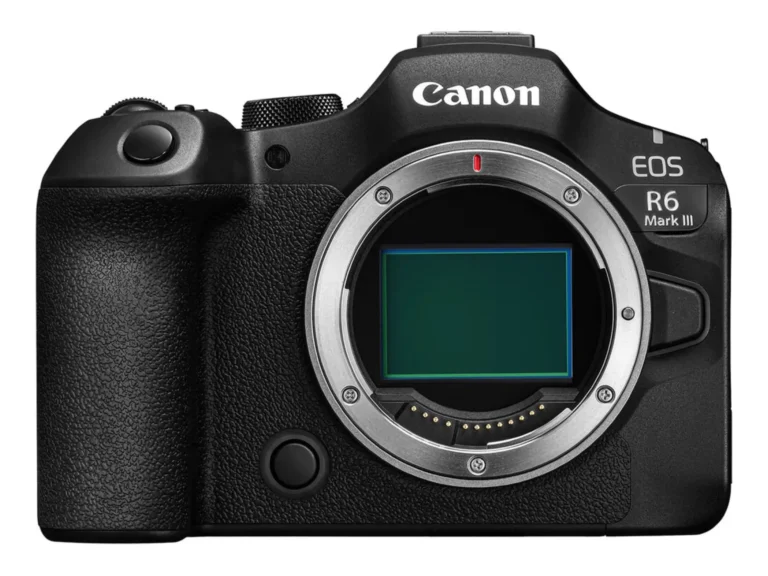
Canon R6 III
Canon EOS R8 (2023) is Canon’s modern entry-level full-frame model. It is essentially a more compact and more affordable version of the Canon EOS R6 Mark II, sharing the same 24 MP sensor and highly advanced autofocus system. Autofocus performance is consistently stronger than that of most current Nikon cameras. The R8 offers oversampled 4K 60 fps 10-bit recording without a crop (although rolling shutter distortion is noticeable). It lacks IBIS, has no mechanical shutter and has only one card slot. It can shoot at up to 40 fps in 12-bit RAW with the electronic shutter (with noticeable rolling shutter distortion).
The R8 is an extremely capable camera, but for photographers, similarly priced entry-level alternatives such as the Nikon Z5 II and Sony A7 III may offer a more well-rounded feature set.
Canon EOS R6 Mark II (2022) was a significant upgrade to its outdated predecessor, the original R6. It brings a newer 24 MP sensor with better detail, less rolling shutter distortion and improved dynamic range. It offers amazing autofocus, continuous shooting at up to 40 fps with the electronic shutter (12 fps mechanical), oversampled 4K 60 fps recording and even 6K RAW external recording. Internal recording is limited to 10-bit with an option of external 12-bit recording.
The R6 II is slightly more expensive than the Nikon ZR or Z6 III, but pricing in this segment can fluctuate over time.
Canon EOS R6 Mark III (2025) is not necessarily a direct successor to the R6 Mark II, instead, it can be seen as an alternative version built around a higher-resolution 32 MP sensor. It retains the speed (up to 40 fps high-speed shooting), extremely reliable autofocus performance and compact design that made the R6 Mark II so popular, while introducing far more high-quality video features like 7K RAW, 4K 120 fps and Open Gate recording.
The R6 III is much more expensive than the Nikon ZR and Nikon Z6 III (the price is similar to the likes of the new Sony A7 V).
Nikon ZR Price
Final Verdict
Nikon ZR represents the first collaboration between Nikon and RED Digital Cinema, combining the strengths of both brands into a unique product. It is a highly accessible option for filmmakers and content creators seeking professional-quality video performance in a compact body, while more advanced users may especially appreciate the inclusion of RED RAW recording.
Nikon Z6 III is the ZR’s closest alternative, as the ZR is essentially a simplified version built around the same sensor and processor, but without an EVF and without the mechanical shutter. If you are not exclusively looking for the most compact option, then the Z6 III is easily the better choice, as it is also excellent for photography and overall Nikon’s most advanced 24 MP camera to date.