
Canon Cameras
Canon EOS R6 V Review
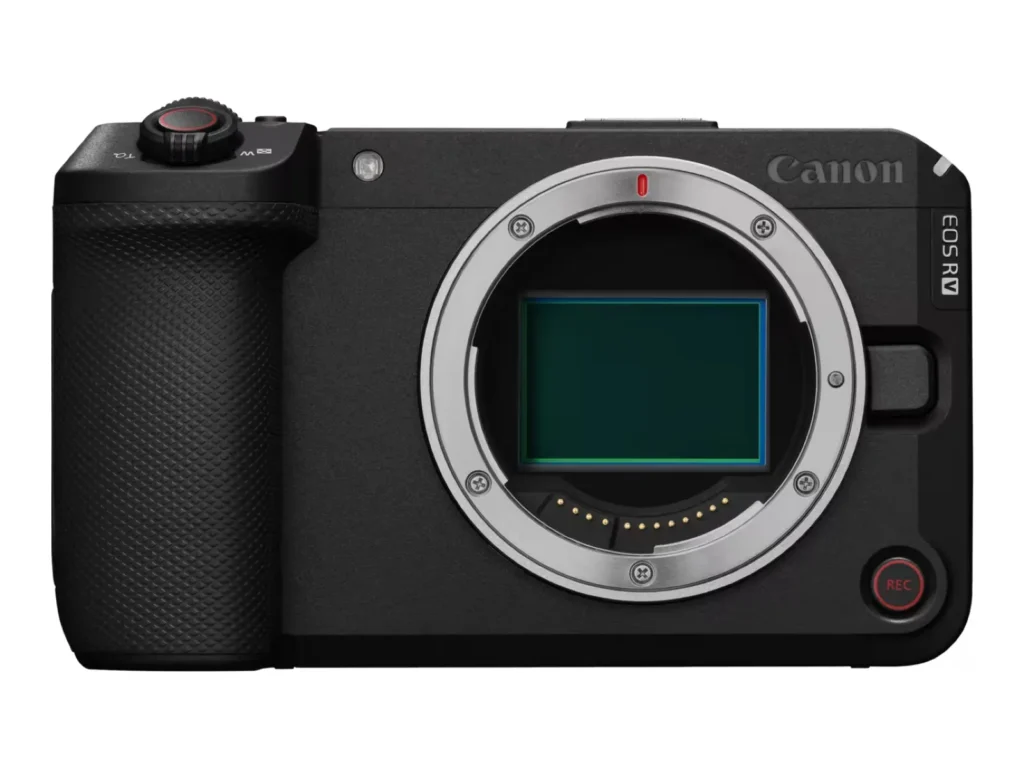
Canon EOS R6 V is Canon’s newest addition to the R6 series. It is essentially a videography-focused version of the R6 Mark III, with both cameras sharing the same 32.5 MP sensor, processor and highly reliable autofocus system.
While most of the core specifications remain identical to those of the R6 Mark III, the R6 V introduces several video-focused features, including an active cooling system for improved thermal performance during extended recording sessions.
To further streamline the video-oriented design and reduce cost, the R6 V also removes the mechanical shutter and electronic viewfinder, making the camera slightly more affordable than the R6 Mark III.
Canon EOS R System
The release of the Canon EOS R in 2018 introduced the Canon RF-mount. With a larger mount diameter, shorter flange distance and a 12‑pin electronic interface, it allowed Canon to design faster, sharper lenses with better low-light performance. Compared to older DSLRs the system is now smaller and lighter while also improving autofocus speed and overall image quality. After nearly a decade, the EOS R System now provides a wide selection of lenses. Canon EF-mount lenses (older DSLR lenses) remain fully compatible with Canon R System cameras via the EF-EOS R adapter.
Canon EOS R6 V Price
Canon EOS R6 V Specifications
General
Canon EOS R6 V features a 32.5 MP full-frame CMOS sensor paired with Canon’s DIGIC X processor. This same sensor was previously used in the Canon EOS C50 and the Canon EOS R6 Mark III.
According to Canon’s official specifications, the IBIS system provides up to 7.5 stops of shake reduction in the center of the frame and 7.0 stops toward the edges (compared to 8.5 stops on the R6 Mark III). Some reviewers have also claimed that stabilization can be rated up to 8.5 stops when certain Canon RF lenses are used.
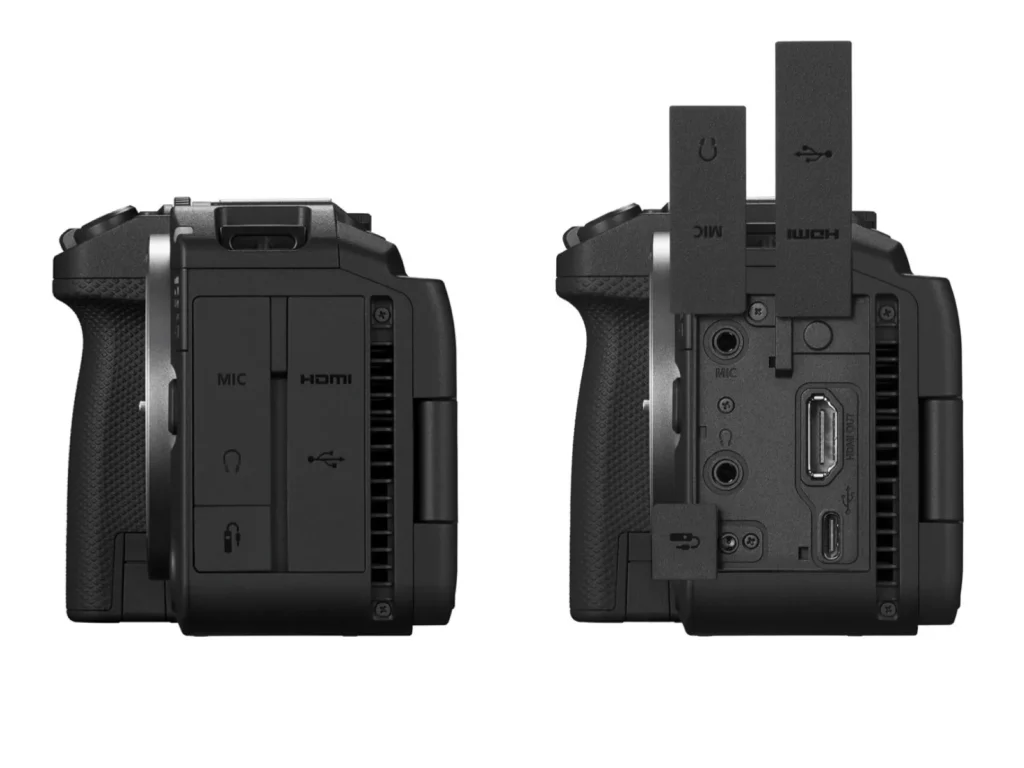
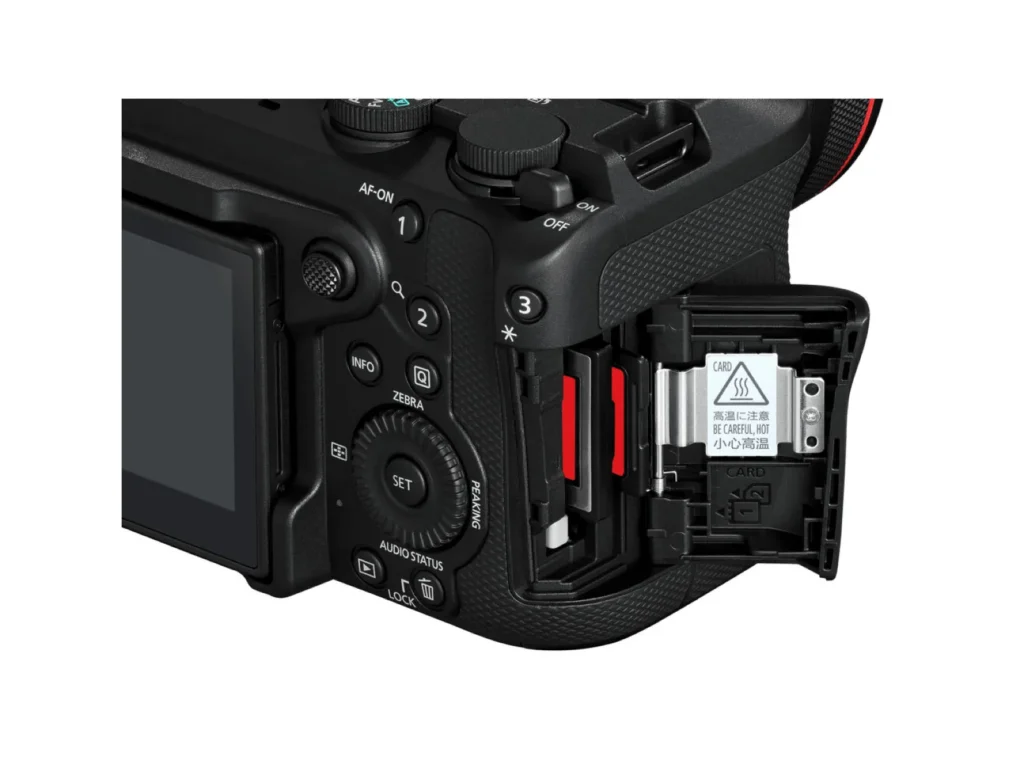
Just like the R6 Mark III, the R6 V also features dual card slots (one SD and one CFexpress Type B), a full-size HDMI port and Canon’s multi-function digital hot shoe. Standard connectivity options such as 3.5 mm microphone and headphone jacks, USB Type-C and a remote terminal are also included.
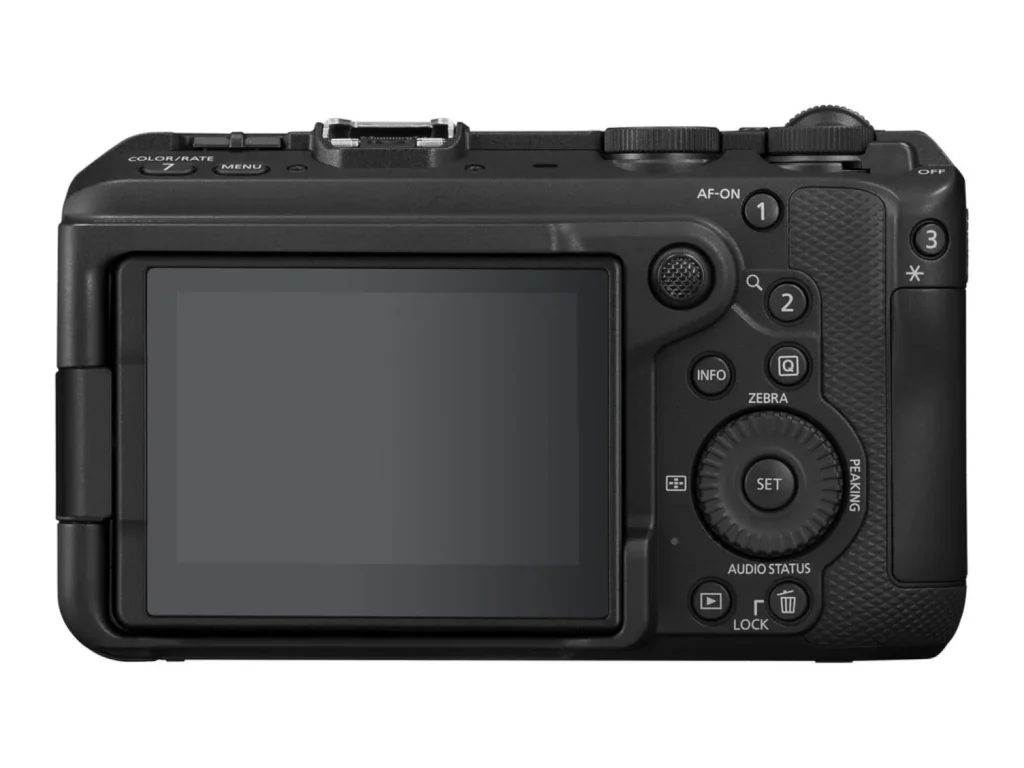
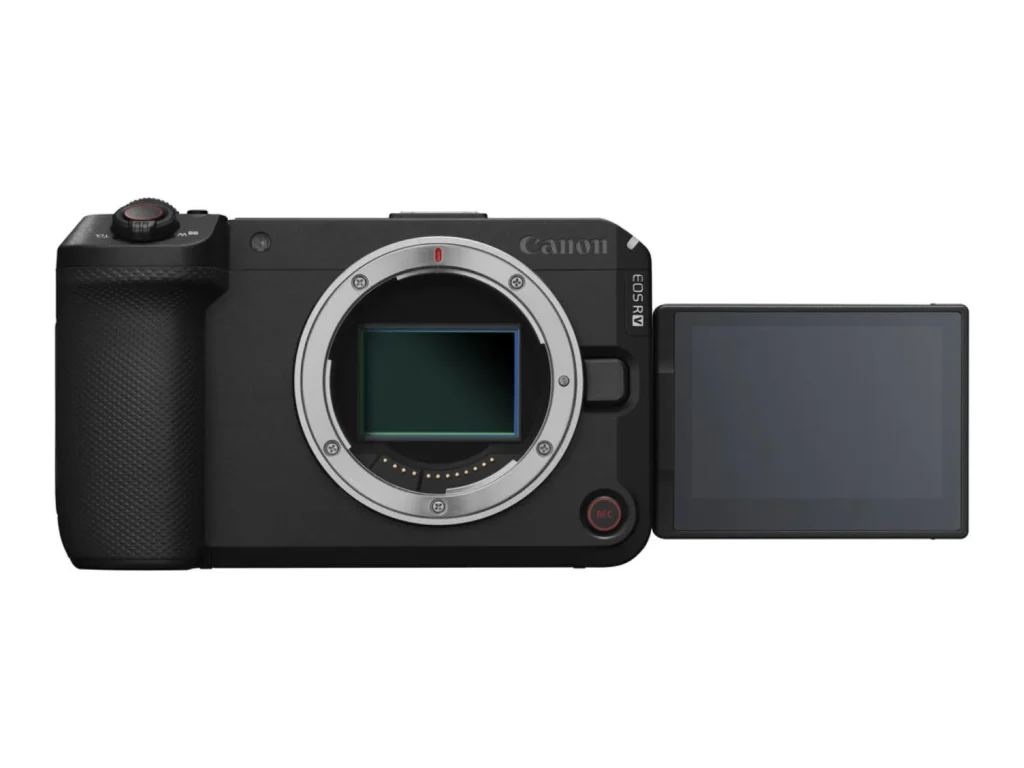
All R6-series cameras use the same fully articulating LCD screen, but the R6 V is the only model in the lineup to offer a dedicated vertical user interface useful for vertical video recording.
The R6 V uses the same LP-E6P battery as the R6 Mark III. The camera is still compatible with older LP-E6NH batteries used in the R6 and R6 Mark II, but the active cooling system and selected other features are disabled when using those older batteries
Body Design
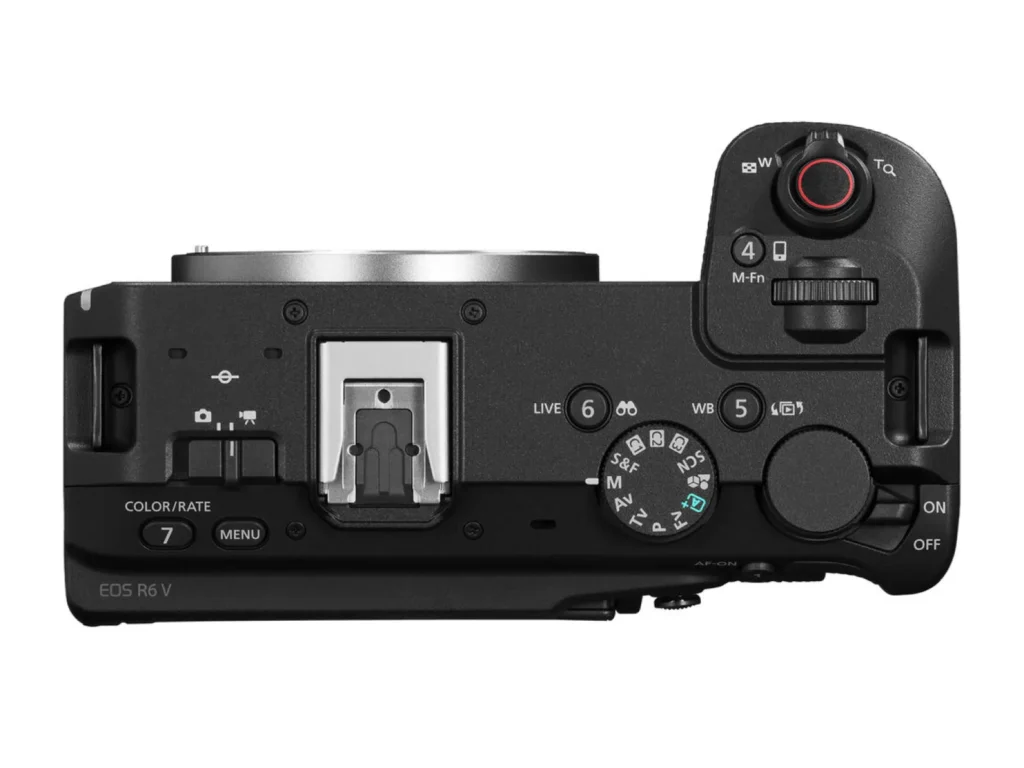
The design of the Canon EOS R6 V is completely different from that of any other camera in the R6 series, with the most noticeable difference being the absence of an electronic viewfinder (EVF).
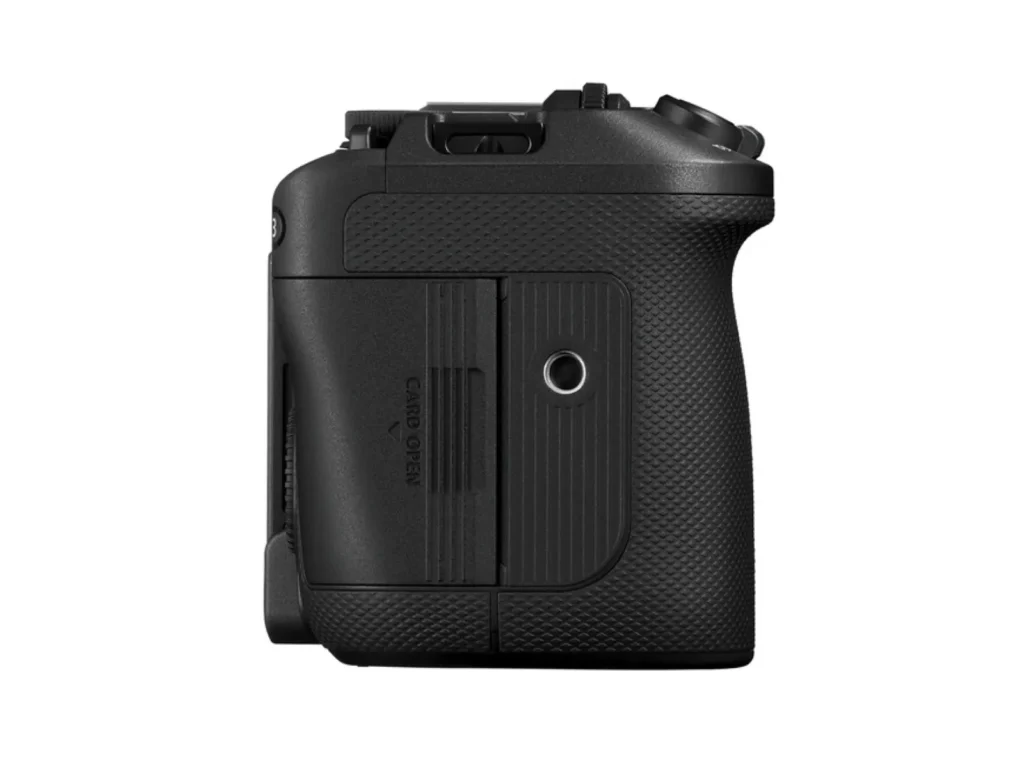
The R6 V has a dedicated heat-dissipating structure and is the only camera in the R6 lineup with an active cooling system. It includes a built-in cooling fan similar to the one found in the Canon EOS C50, although the R6 V is more compact and therefore uses a smaller, less powerful fan
In addition to the standard tripod mount on the bottom of the camera, there is also an extra mounting point on the right side next to the card slot compartment.
The rear layout is very similar to the C50, although with slightly fewer buttons due to the more compact body design.
Other changes include a new photo/video mode switch on the left side of the camera, an additional record button on the front and a zoom rocker surrounding the traditional shutter/record button. The zoom rocker can be used with powered zoom lenses (including the new 20-50mm RF Lens that Canon announced alongside the R6 V).
Autofocus
Canon’s autofocus system is widely regarded as one of the best in the industry. The R6 V uses Canon’s ‘Dual Pixel CMOS AF II’ system with an AI-based deep-learning engine for enhanced subject tracking with better stickiness. A similar system was also previously used in the EOS R6 Mark II, R6 Mark III, EOS R8 and Canon’s previous ‘flagship’ EOS R3.
The camera can recognize a wide range of subjects, including people, animals (dogs, cats, birds, horses) and various vehicles (cars, motorcycles, bicycles, trains and aircraft).
The R6 V supports Eye-Detection AF for humans and animals and it maintains focus reliably even in low-light conditions. You can even manually select the preferred right or left eye, switch focus points using the joystick or allow the camera to choose automatically.
Autofocus performance is extremely reliable in virtually all situations.
Photography
Canon EOS R6 V is clearly not designed as a dedicated photography camera. It lacks an electronic viewfinder (EVF) and has no mechanical shutter.
Most of the core photography features remain identical to those of the Canon EOS R6 Mark III.
The R6 V can shoot at up to 40 fps with the electronic shutter, just like the R6 Mark III. In this mode, the buffer fills after approximately 4 seconds, allowing for around 140–150 RAW frames. When shooting JPEGs, the buffer increases to more than 300 frames. Using older or slower SD cards can negatively affect both buffer depth and, especially, buffer clearing times.
Keep in mind that the R6 V does not include a mechanical shutter, meaning all photos are captured exclusively using the electronic shutter. Like the R6 Mark III, the R6 V also uses 12-bit A/D conversion instead of 14-bit readout in order to achieve 40 fps shooting speeds while minimizing rolling shutter distortion.
The Pre-Capture mode can record up to 20 RAW images (half a second) before the shutter button is fully pressed.
| Feature | Canon EOS R6 V |
|---|---|
| Release Date | May 2026 |
| Megapixels | 32.5 MP |
| Image Resolution | 6960 × 4640 |
| Sensor Size | Full Frame |
| Sensor Type | CMOS |
| Image Processor | DIGIC X |
| IBIS | 5-axis, 7.5 stops |
| Weather Sealing | Yes |
| Lens Mount | Canon RF |
| Body Type | Mirrorless |
| PHOTO | |
| Native ISO | 100 – 64,000 |
| Expandable ISO | 50 – 102,400 |
| Shutter Speed | 1/16000 – 30s |
| Burst Rate (Mechanical) | / |
| Burst Rate (Electronic) | 40 fps RAW (12-bit) |
| Buffer | ~ 150 RAW (at 40 fps) |
| Shutter Types | Electronic |
| Silent Shooting | Yes (Electronic Shutter) |
| Exposure Compensation | ±3 EV |
| High-Res (Sensor Shift) | No |
| Pre-Capture Mode | Yes |
| VIDEO | |
| 4K Video | 4K 60fps (oversampled from 7K) |
| Max Frame Rate | 7K 60fps / 4K 120fps / 1080p 180fps |
| Bit Depth | 12-bit |
| Recording Limit | 6 hours |
| Timelapse Recording | Yes |
| AUTOFOCUS | |
| AF System | 'Dual Pixel CMOS AF II' + AI-based deep-learning engine for enhanced subject tracking |
| AF Points | 1053 |
| AF Coverage | 100% Frame Coverage |
| AF Joystick | Yes |
| DISPLAY / VIEWFINDER | |
| Articulated Screen | Fully Articulating |
| Touch Screen | Yes |
| LCD Size | 3" |
| LCD Resolution | 1,620,000 |
| EVF Resolution | / |
| EVF Refresh Rate | / |
| EVF Coverage | / |
| EVF Magnification | / |
| MORE INFO | |
| Card Slot 1 | CFexpress Type B |
| Card Slot 2 | SD (UHS-II) |
| Sensor Protection System | No |
| USB | Type C 3.2 Gen 2 |
| USB Charging | Yes |
| HDMI | Type A (Full Size HDMI) |
| Microphone Port | 3.5 mm |
| Headphone Port | 3.5 mm |
| Built-in Flash | No |
| Built-in Microphone | Yes |
| Battery | LP-E6P |
| Battery Life | ~ 510 frames |
| Wi-Fi / Bluetooth | Yes |
| Dimensions | 142 × 83 × 80 mm |
| Weight | 688 g |
Video
Video recording is, of course, the standout strength of the R6V. It offers all of the same video recording features as the R6 Mark III.
Canon EOS R6 V can record in 7K 60 fps internally without a crop in Canon’s Cinema RAW format.
It can also record oversampled 4K 60 fps internally without a crop. 4K footage is oversampled from 7K, delivering excellent detail, strong dynamic range and natural colors; however, rolling shutter is noticeable when tracking fast-moving subjects.
You have the option to select either 4K ‘Fine’ recording or ‘Standard’, with ‘Standard’ offering less detail since the footage is not oversampled (but there is less rolling shutter distortion).
On the Canon EOS R6 Mark III, oversampled 4K 60 fps ‘Fine’ footage appears to be slightly less detailed than 4K 30 fps ‘Fine’ footage, likely due to reduced processing time per frame. It is reasonable to assume that the same applies to the new R6V. That said, the difference is minor and unlikely to present any real-world issue, with most users probably never noticing it at all.
4K 120 fps recording with audio is available, but this mode is not oversampled.
Full HD (1080p) recording is available at up to 180 fps.
The R6 V can record internally and externally (via HDMI) in up to 12-bit. Just like with the R6 Mark III, you can use Canon’s C-Log 3 and even C-Log 2. C-Log 2 footage preserves more dynamic range and is a feature that was previously reserved for Canon’s Cinema cameras. Using C-Log 2 or C-Log 3 allows you to set the color space to “Cinema Gamut,” enabling the use of Canon’s official LUTs for excellent color reproduction (accessible on Canon’s support pages).
The R6 V supports simultaneous recording to both memory cards.
Streaming via USB-C is available in 4K and at up to 60 fps (a feature not present in the R6 III).
This is the first Canon camera to include a Pre-Recording mode, similar to the Pre-Capture feature used for photography. When enabled, the camera continuously records video to an internal cache (rather than directly to the memory card). Once you press the record button, the last few seconds of buffered footage are also saved with the footage recorded after pressing the button. You can choose between 3 or 5 seconds of pre-recording. Keep in mind that this is a relatively new feature and it is not available when recording RAW video.
Open Gate Recording
Canon R6 Mark III and R6 V are the only Canon cameras to include Open Gate recording (outside of Canon’s Cinema line). Open Gate captures the entire sensor area to produce a 3:2 image, allowing extensive reframing in post-production. This feature is available in up to 7K 30 fps and even when recording in 12-bit RAW.
When shooting Open Gate, ‘Aspect Marker’ settings allow you to display multiple custom markers on screen for various aspect ratios to assist with framing while recording.
Heat Management and Recording Limit
Overheating has been a known issue with some Canon cameras, especially the Canon R5 and the original R6. However, the situation is different with Canon’s more video-focused models.
Canon EOS R6 V features a heat-dissipating body design along with a built-in cooling fan. Fan speed can be adjusted in-camera, with three available settings: Low, Medium and High. Keep in mind that the fan may be audible if you are recording audio with a microphone positioned close to the camera.
According to Canon, the R6 V can record for up to 2 hours in most recording modes without overheating, or around 1 hour in hotter environments. In many cases, this means the battery may run out before overheating becomes an issue.
The R6 V has a maximum clip length of 6 hours in most recording modes and 2 hours in high-frame-rate modes above 100 fps. Battery life is sufficient for more than 1 hour of continuous video recording. USB-C power delivery can be used to extend battery life.
Canon EOS R6 V Alternatives
Canon R6 III
Canon R6 II
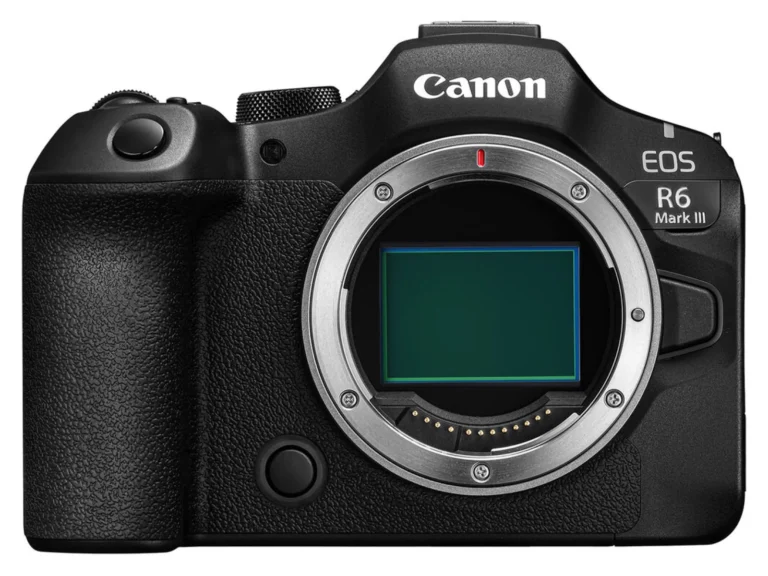
Canon EOS R6 Mark III (2025) is Canon’s most advanced camera in the R6 series. It is an extremely capable hybrid camera capable of producing excellent video resulting and also photography results, while the new R6 V is strictly designed for video recording. Both cameras share the same 32.5 MP sensor, processor, highly reliable autofocus system with and both offer all the same video recording modes.
Canon R6 III is about $300 more expensive than the R6 V.
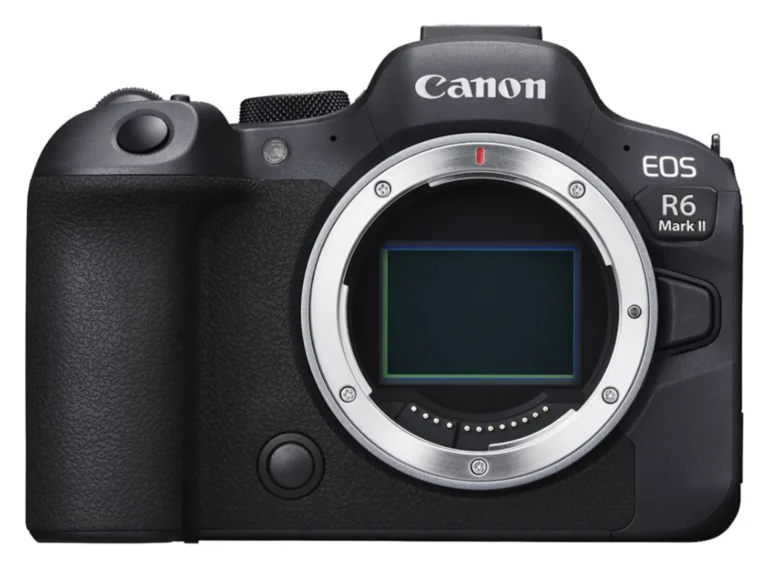
Canon EOS R6 Mark II (2022) is a more affordable model of the R6 series with a 24 MP sensor. It uses the same extremely reliable autofocus system and offers continuous shooting up to 40 fps, oversampled 4K 60 fps recording and even 6K RAW external recording.
Nikon Z6 III
Nikon Z6 III
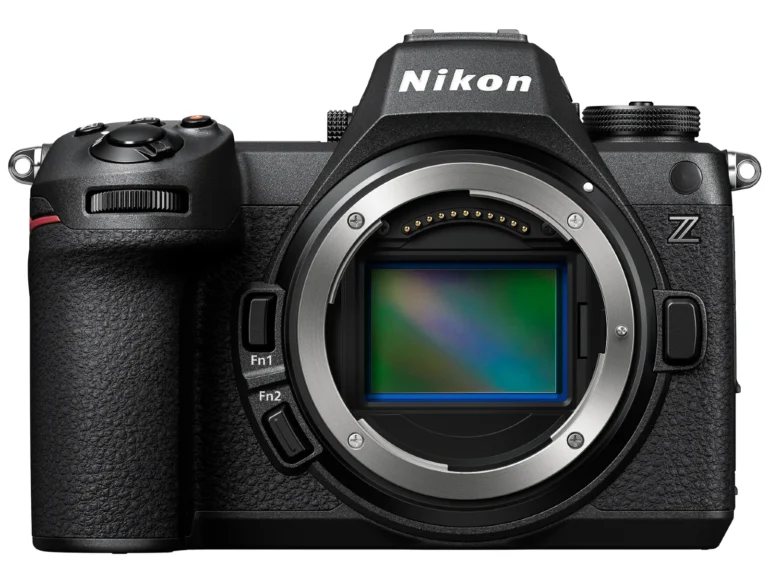
Nikon Z6 III (2024) is Nikon’s most advanced 24 MP camera, featuring a partially stacked 24 MP BSI sensor, an EXPEED 7 processor and class-leading autofocus and video capabilities including internal 6K 60 fps 12-bit N-RAW recording, oversampled 4K 60 fps recording and 4K 120 fps with a 1.5x crop. It can shoot at 14 fps in RAW with a mechanical shutter and 20 fps in RAW with the electronic shutter (60 fps in full-res JPEG and 120 fps in 11 MP JPEG).
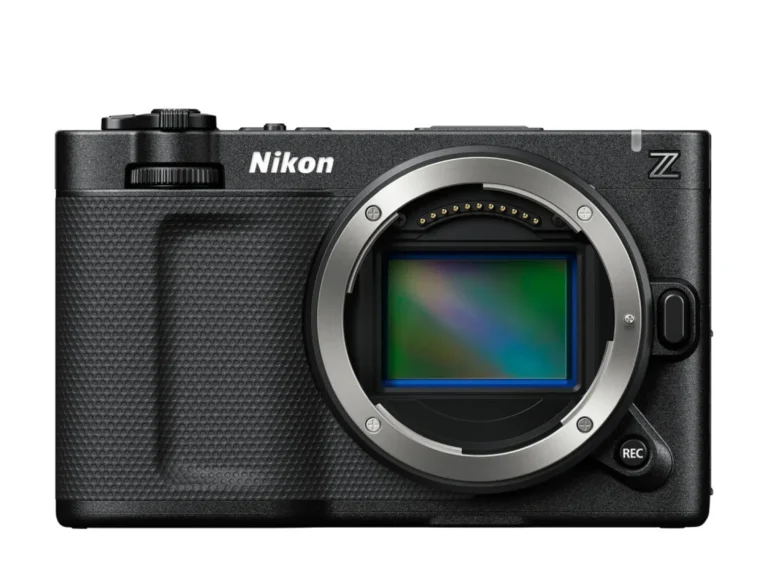
Nikon ZR (2025) is essentially the Nikon Z6 III in a much more compact body with the same 24 MP partially-stacked sensor, EXPEED 7 processor and the same autofocus system. It removes the EVF and the mechanical shutter (in that sense making it similar to the Canon R6 V).
It offers all the same video recording features as the Z6 III – 6K 60 fps 12-bit N-RAW recording, oversampled 4K 60 fps recording and 4K 120 fps with a 1.5x crop. The only difference is that it includes the option of internal 12-bit RED RAW recording. RED RAW is an extremely high-quality codec, borrowed from professional RED cinema cameras.
Both models are cheaper than the Canon R6 V. The Z6 III is about $500 cheaper and the ZR is about $300 cheaper, but pricing in this segment can fluctuate over time.
Sony A7 V
Sony A7 IV
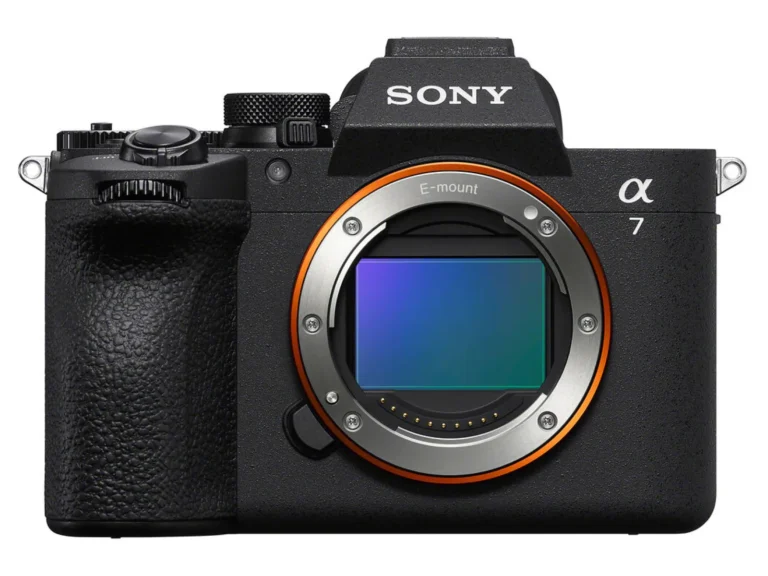
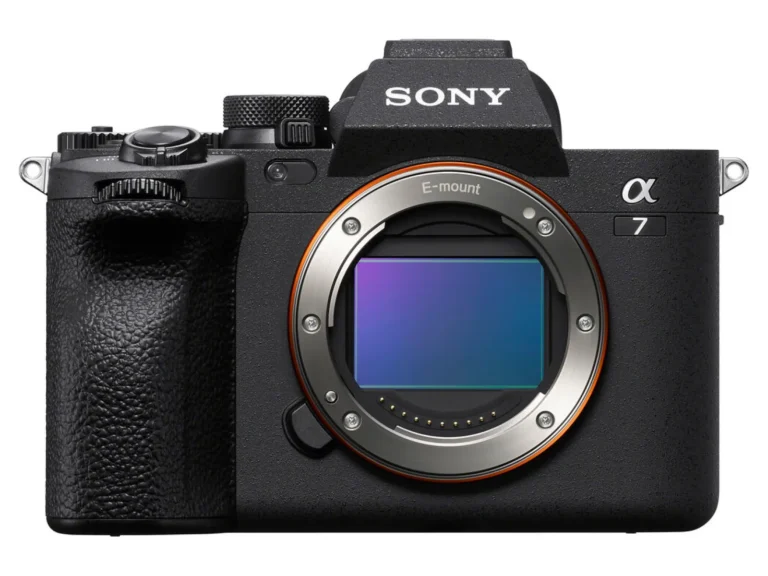
Sony A7 V (2025) uses a partially-stacked 33 MP BSI sensor with fast readout, resulting in excellent autofocus performance, minimal rolling shutter distortion and great high-speed shooting performance (up to 20 fps with the electronic shutter and up to 30 fps with Sony-branded lenses). It also introduces a new BIONZ XR2 processor with a built-in AI processing unit and a new hybrid screen design (tilting and fully articulating). Video recording is limited to 4K and to 10-bit (there is no internal or external 12-bit RAW recording option).
Sony A7 V currently represents great value, especially compared to the Sony A7 IV. The A7 V is more expensive than the Canon R6 V. Canon R6 Mark III and A7 V current have the same price.
Sony A7 IV (2021) uses a slightly older 33 MP BSI sensor, but it still offers advanced autofocus, making it a powerful hybrid option for both still photographers and video creators. However, the camera does have some drawbacks. High-speed shooting is limited to just 6 fps in RAW (10 fps compressed RAW) and while video capabilities include 4K 60 fps, rolling shutter can be a serious issue due to the high-megapixel sensor (though dynamic range remains excellent).
Canon EOS R6 V Price
Final Verdict
Canon EOS R6 V is a videography-focused version of the Canon EOS R6 Mark III. Both are extremely capable cameras that share the same 32.5 MP sensor, processor, highly reliable autofocus system and identical video recording options. The main difference lies in the body design and intended use.
The R6 V is designed almost exclusively for video work, featuring an active cooling system for extended recording times, while the R6 Mark III is a more versatile hybrid camera with an EVF and a mechanical shutter that is equally well suited for photography and video. This ultimately makes the choice fairly straightforward: if you plan to take photography even somewhat seriously, the R6 Mark III is definitely the better option.