
Canon Cameras
Canon EOS R10 Review
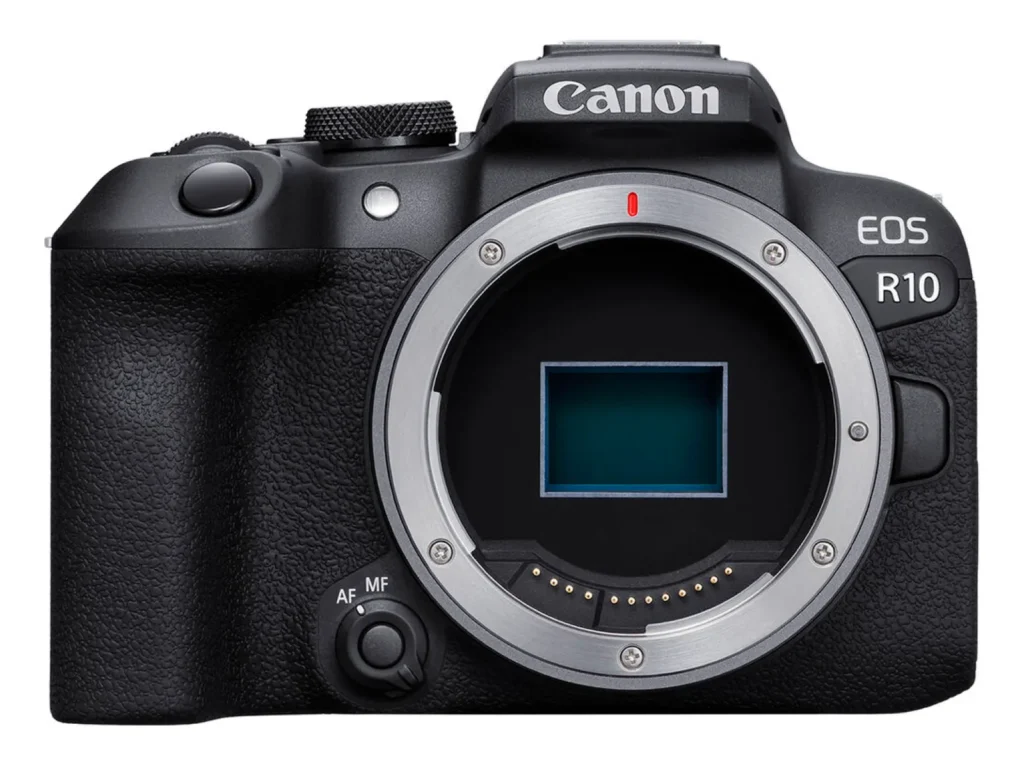
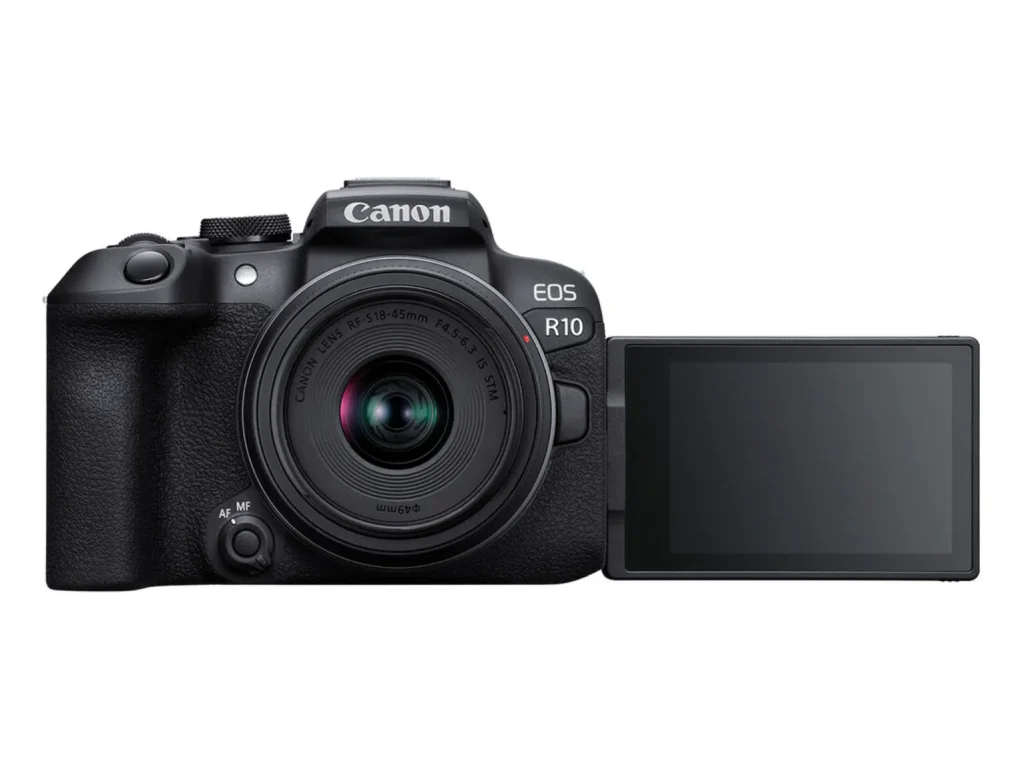
In May 2022, Canon released its first mirrorless APS-C cameras for the new EOS R system: the EOS R7 and EOS R10. The R10 was designed as a versatile entry-level APS-C model featuring a 24 MP sensor, while the R7 targeted photographers who required higher resolution and more advanced features.
Since then, Canon has expanded its APS-C EOS R lineup with several more affordable models and the EOS R10 now sits between the more affordable entry-level R50 and the more advanced R7.
Canon EOS R System
The release of the Canon EOS R in 2018 introduced the Canon RF-mount. With a larger mount diameter, shorter flange distance and a 12‑pin electronic interface, it allowed Canon to design faster, sharper lenses with better low-light performance. Compared to older DSLRs the system is smaller and lighter while also improving autofocus speed and overall image quality. After nearly a decade, the EOS R System now provides a wide selection of lenses. Canon EF-mount lenses (older DSLR lenses) remain fully compatible with Canon R System cameras via the EF-EOS R adapter.
Canon EOS R10 Price
Canon EOS R10 Specifications
General
Canon EOS R10 features a new 24.2 MP APS-C sensor paired with Canon’s DIGIC X processor. Canon’s APS-C sensors are slightly smaller, effectively providing a 1.6x crop factor compared to the 1.5x crop found in many other camera brands.
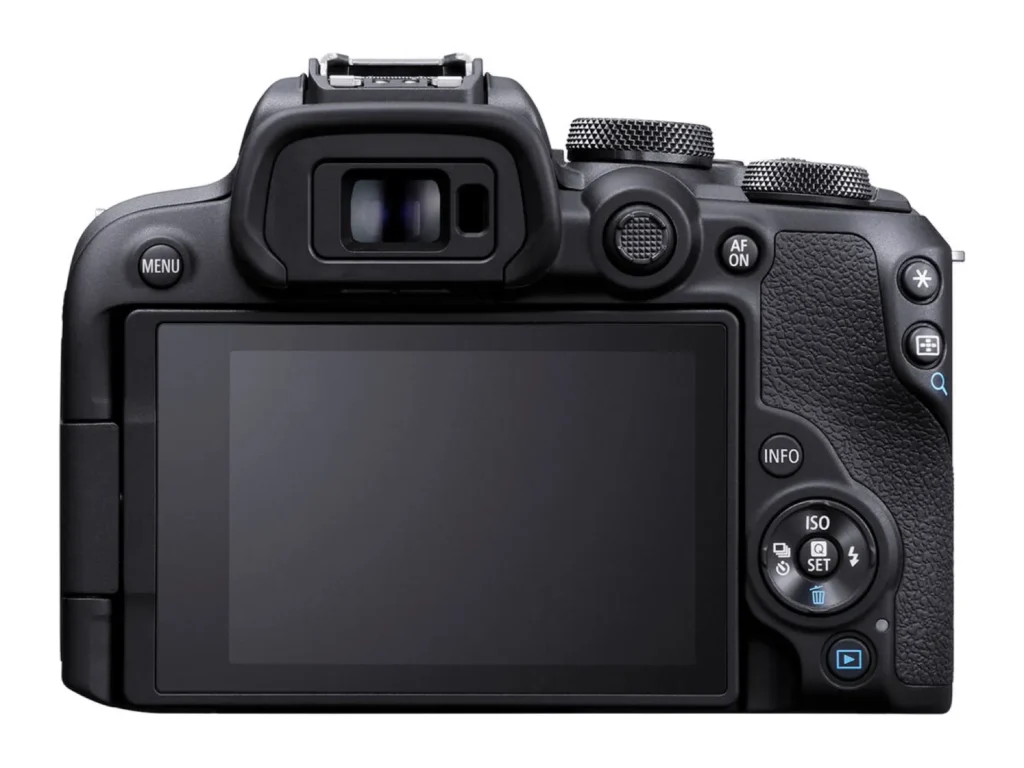
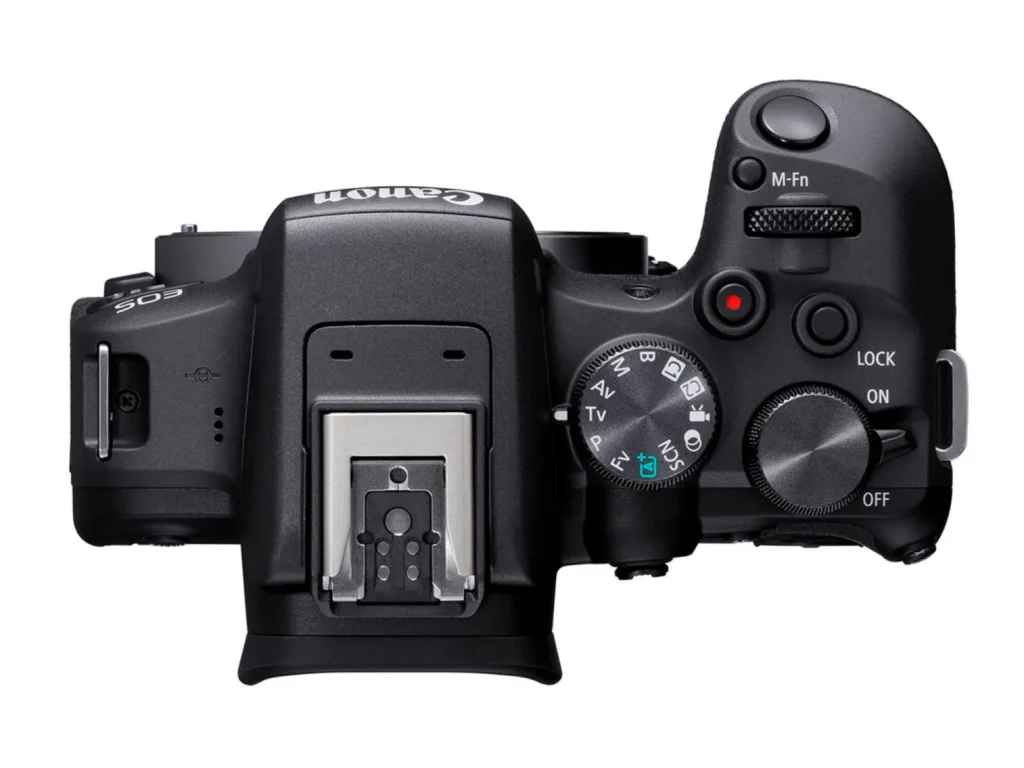
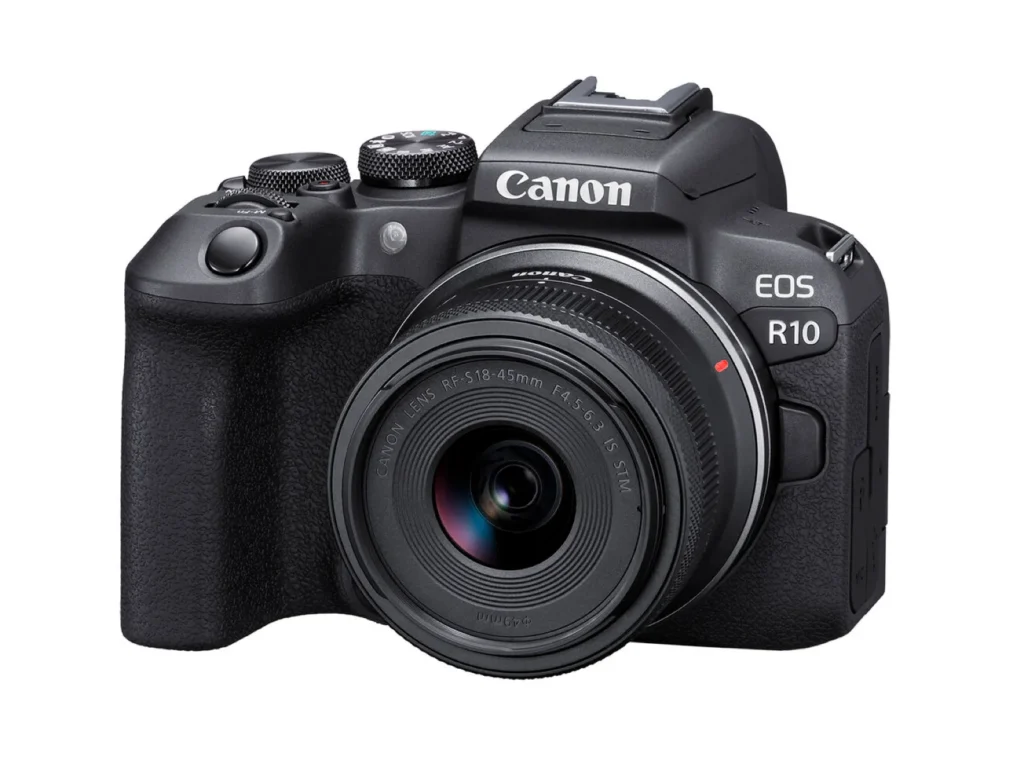
The body is ergonomic and comfortable to hold and the R10 also includes an AF joystick, a feature rarely seen on APS-C cameras. The “Lock” button on the top of the camera is used to lock and unlock settings. Some reviewers note that it can be easy to press accidentally or without realizing it, which prevents settings from being changed until the button is pressed again. The button also cannot be customized.
The R10 features a fully articulating LCD screen. The EVF offers selectable refresh rates of 120 fps or 60 fps (power-saving mode).
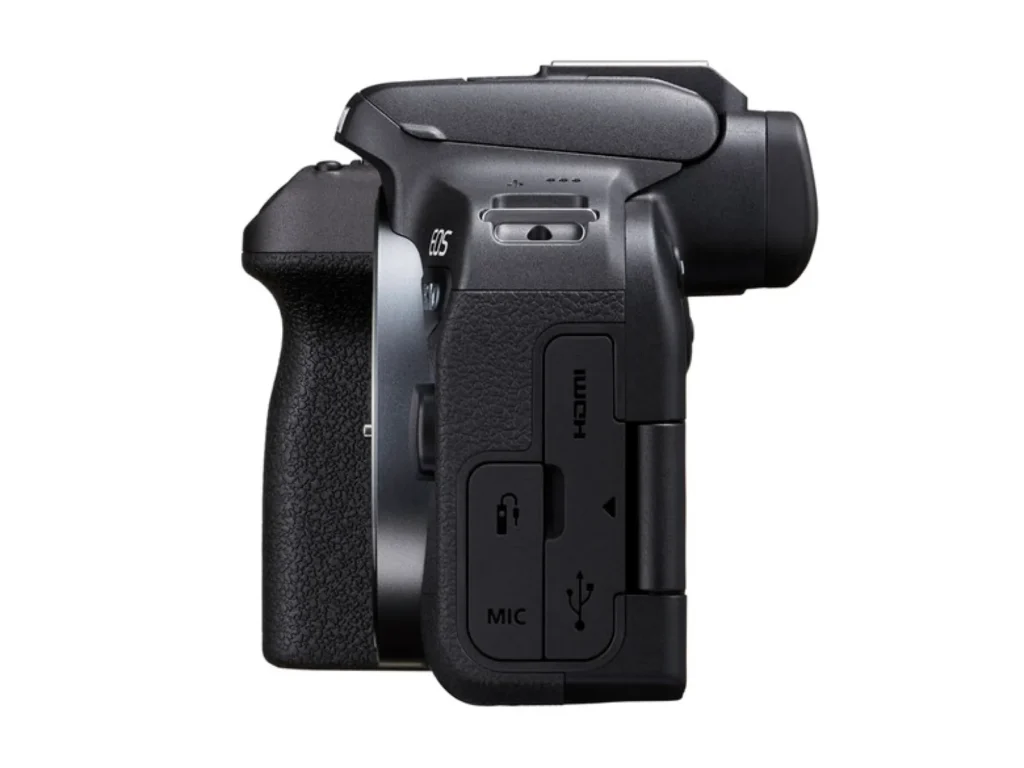
There is only one SD card slot. The R10 does not offer weather sealing or in-body image stabilization (IBIS) and there is no headphone jack (only a microphone jack).
The batteries used in Canon APS-C cameras are smaller than those designed for full-frame models, so purchasing an additional battery is highly recommended.
Autofocus
Canon’s autofocus is generally considered one of the strongest systems in the industry. Canon EOS R10 uses Canon’s ‘Dual Pixel CMOS AF II’ system.
Eye-detection AF is available for both humans and animals and it performs well even when the subject is moving, though performance decreases when there are distractions in the foreground. Subject tracking is available for humans, animals (dogs, cats and birds) and vehicles (cars and motorcycles).
When the camera recognizes multiple subjects, you can use the AF joystick to switch tracking between them.
Autofocus performs well for photography. However, in video mode the camera may occasionally shift focus to the background or foreground instead of the intended subject. Adjusting autofocus settings is often necessary to achieve more consistent results across different situations.
Overall autofocus performance on the Canon EOS R10 is good, but it does not match the performance of Canon’s full-frame cameras or the more advanced and more expensive EOS R7.
Photography
Image quality is impressive for an APS-C sensor, providing good dynamic range and natural color rendering Canon is known for.
With the mechanical shutter, the R10 can shoot at up to 15 fps in 14-bit RAW with full autofocus. However, the buffer is quite small and after only about two seconds (around 30 frames) the shooting speed drops significantly before eventually stopping to clear the buffer.
Using the electronic shutter increases the burst rate to 23 fps in RAW with full autofocus, but in this case the buffer fills in just a second (around 20-30 shots). Using the electronic shutter also results in noticeable rolling shutter distortion when photographing fast-moving subjects. The R10 is believed to reduce RAW capture to 12-bit A/D conversion when using the electronic shutter, consistent with most Canon EOS R-series cameras without stacked sensors. However, Canon does not clearly document this behavior in the official R10 specification sheet.
The buffer performance improves significantly when shooting JPEGs, allowing almost 500 shots with the mechanical shutter and almost 100 with the electronic shutter.
Video
Canon EOS R10 can record oversampled 4K video at 30 fps using the full width of the sensor. Footage is oversampled from 6K and very detailed considering the APS-C sensor size, though rolling shutter can be an issue.
4K 60 fps is also available, but only with a 1.56× crop. This mode is not oversampled, resulting in noticeably reduced sharpness.
Full HD (1080p) recording is available at up to 120 fps.
Recording is limited to 8-bit, with a 10-bit option available only in the new HDR PQ mode.
The R10 does not include in-body image stabilization (IBIS). Electronic stabilization is available, but it applies an additional crop. While it can be very effective for stationary handheld shots, it is much less effective for handheld video while walking, especially when using slower shutter speeds.
The camera has a 2 hour recording limit. According to official figures, the R10 can record around one hour of oversampled 4K before overheating becomes a concern.
| Feature | Canon EOS R10 |
|---|---|
| Release Date | May 2022 |
| Megapixels | 24.2 MP |
| Image Resolution | 6000 × 4000 |
| Sensor Size | APS-C |
| Sensor Type | CMOS |
| Image Processor | DIGIC X |
| IBIS | No |
| Weather Sealing | No |
| Lens Mount | Canon RF |
| Body Type | Mirrorless |
| PHOTO | |
| Native ISO | 100 – 32,000 |
| Expandable ISO | 100 – 51,200 |
| Shutter Speed | 1/16000 – 30s |
| Burst Rate (Mechanical) | 15 fps RAW |
| Burst Rate (Electronic) | 23 fps RAW (12-bit) |
| Buffer | ~ 30 RAW |
| Shutter Types | Mechanical, Electronic, EFCS |
| Silent Shooting | Yes (Electronic Shutter) |
| Exposure Compensation | ±3 EV |
| High-Res (Sensor Shift) | No |
| Pre-Capture Mode | No |
| VIDEO | |
| 4K Video | 4K 30fps (oversampled from 6K) |
| Max Frame Rate | 4K 60fps (1.56x crop) / 1080p 120fps |
| Bit Depth | 8-bit |
| Recording Limit | 2 hours |
| Timelapse Recording | Yes |
| AUTOFOCUS | |
| AF System | 'Dual Pixel CMOS AF II' |
| AF Points | 651 |
| AF Coverage | 100% Frame Coverage |
| AF Joystick | Yes |
| DISPLAY / VIEWFINDER | |
| Articulated Screen | Fully Articulating |
| Touch Screen | Yes |
| LCD Size | 2.95" |
| LCD Resolution | 1,040,000 |
| EVF Resolution | 2,360,000 |
| EVF Refresh Rate | 120 fps |
| EVF Coverage | 100% |
| EVF Magnification | 0.95× |
| MORE INFO | |
| Card Slot 1 | SD (UHS-II) |
| Card Slot 2 | / |
| Sensor Protection System | No |
| USB | Type C 2.0 |
| USB Charging | Yes |
| HDMI | Type D (Micro HDMI) |
| Microphone Port | 3.5 mm |
| Headphone Port | No |
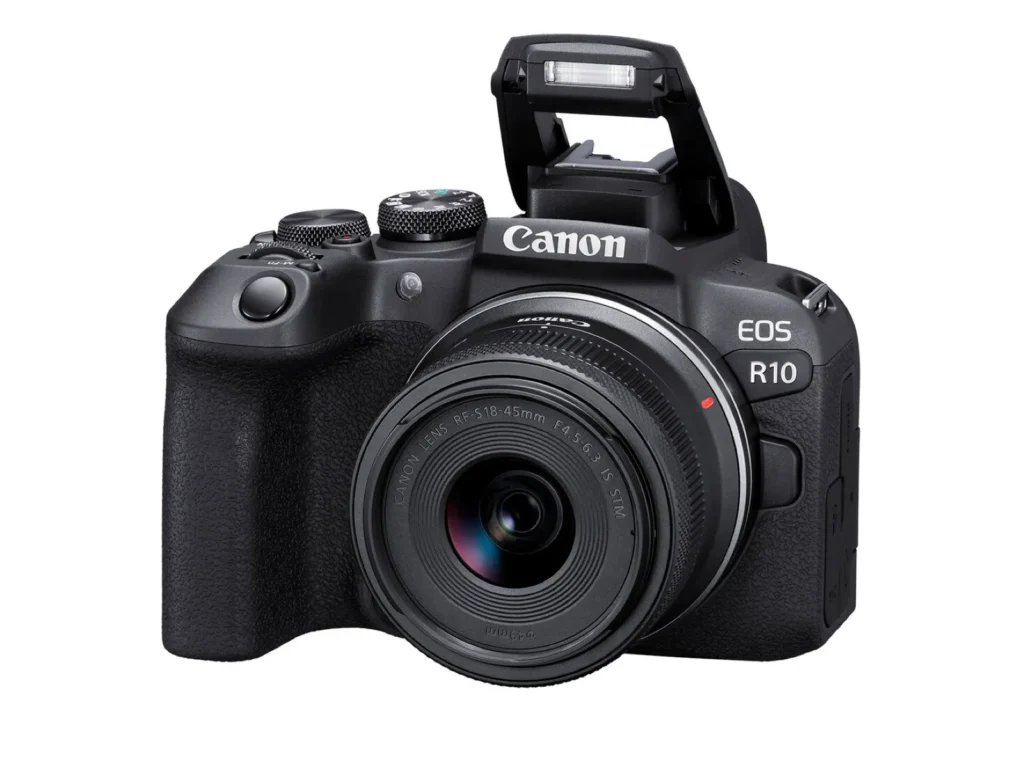
| Built-in Flash | Yes |
| Built-in Microphone | Yes |
| Battery | LP-E17 |
| Battery Life | ~ 400 frames |
| Wi-Fi / Bluetooth | Yes |
| Dimensions | 123 × 88 × 83 mm |
| Weight | 429 g |
Canon EOS R10 Alternatives
Canon R7
Canon R50
Canon R50 V
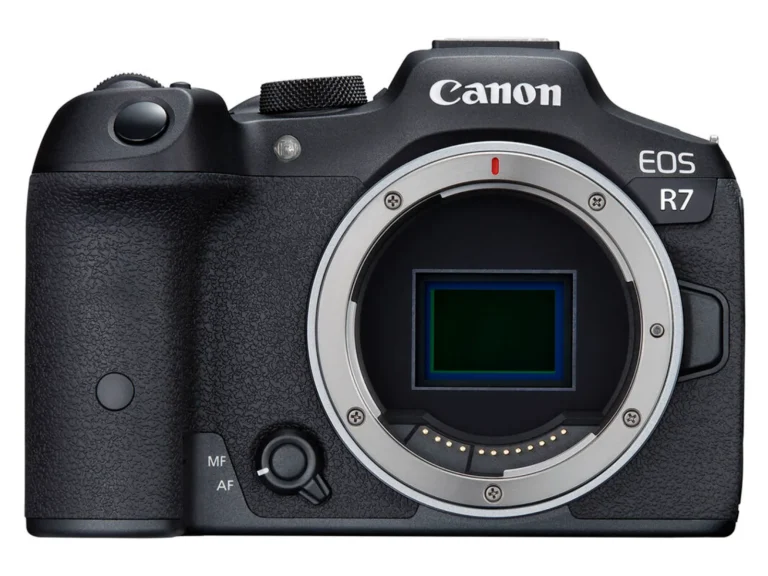
Canon EOS R7 (2022) is Canon’s most advanced and most expensive APS-C model. It features a 32 MP sensor. It has the same reliable AF system as the R10. It offers weather resistance, IBIS, dual SD card slots, 15 fps mechanical and 30 fps electronic bursts. It can record 4K video at up to 60 fps and oversampled 4K video at up to 30 fps (oversampled from 7K, but with visible rolling shutter distortion in all modes).
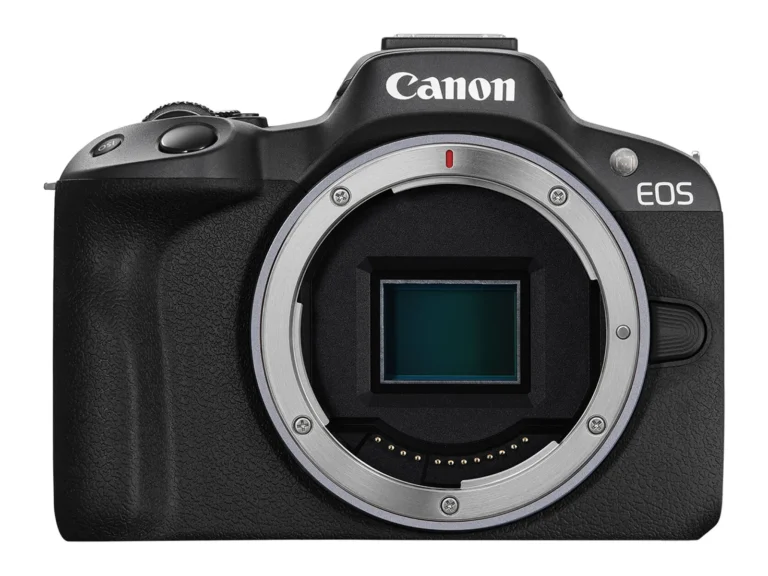
Canon EOS R50 (2023) is Canon’s entry-level APS-C mirrorless camera. It has the same 24 MP sensor and the same processor as the R10, but it has no mechanical shutter. It can record oversampled 4K video at 30 fps. It can shoot up to 12 fps with the EFCS and 15 fps with the electronic shutter, but the buffer is very limited (only 7 RAW images) since the R50 accepts only slower UHS-I SD cards.
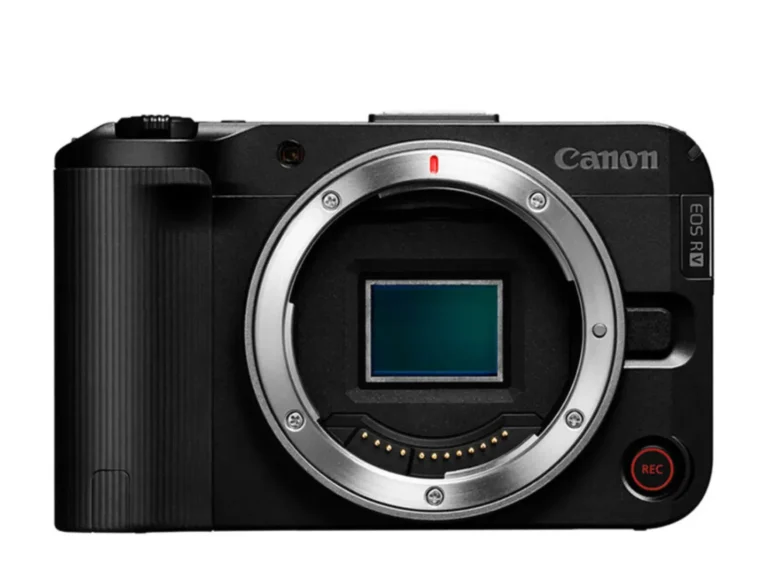
Canon EOS R50 V (2023) is essentially the R50 with a simplified, compact design without a viewfinder. It keeps the same 24 MP sensor and the same processor and AF system. Just like the R50, the R50 V also doesn’t have a mechanical shutter. It can record 4K video at 60 fps with a 1.56x crop and oversampled 4K video at 30 fps in 10-bit. It’s very lightweight, making it ideal for vloggers and social media content creators. It’s also compatible with faster UHS-II SD cards, significantly increasing the buffer compared to the R50.
Nikon Z50 II
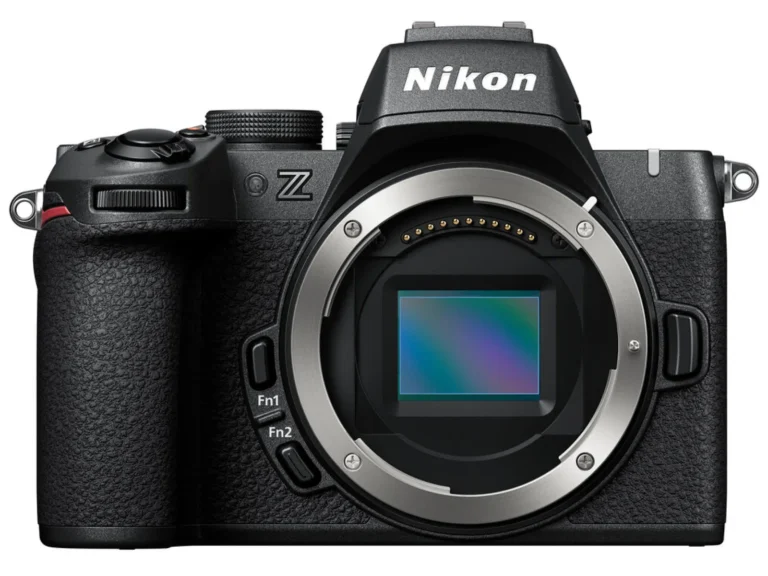
Nikon Z50 II (2024) is a direct competitor to the Canon R10. It has a 21 MP BSI sensor and uses a new version of Nikon’s hybrid AF system. It can record 4K video at up to 30 fps and at up to 60 fps with a 1.5x crop in 10-bit, but the footage is not oversampled. It can shoot at up to 11 fps with the mechanical shutter and up to 15 fps in RAW with the electronic shutter (30 fps in JPEG).
Sony a6100
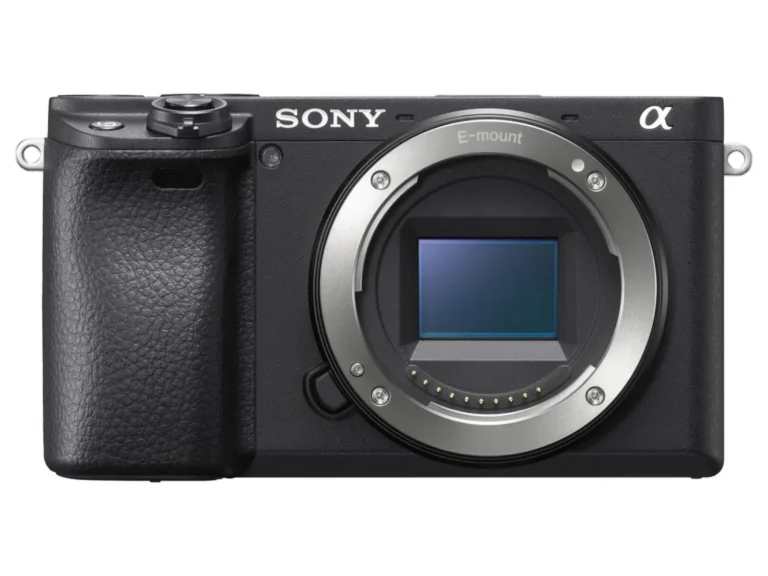
SONY a6400
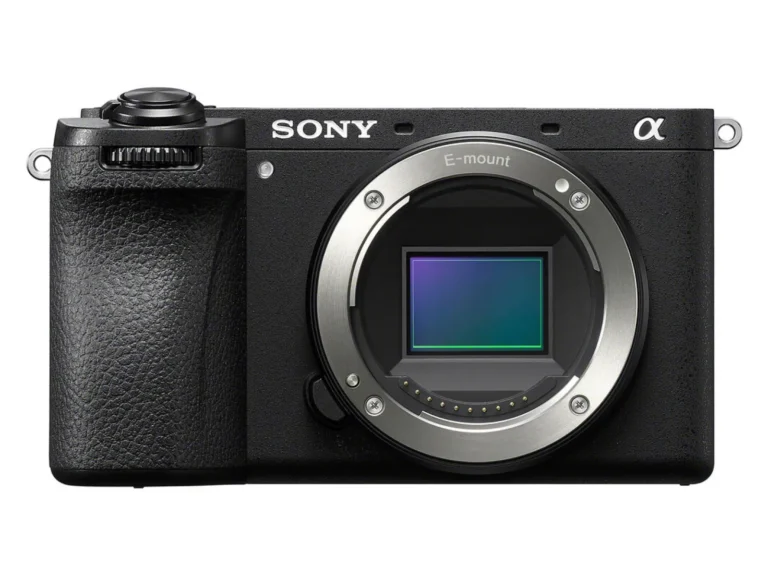
SONY a6700
Sony’s APS-C lineup, commonly referred to as the a6000 series, includes some of the most popular beginner and hobbyist cameras on the market. They’re compact, lightweight and offer fast autofocus and great image quality. They benefit from Sony’s long-standing E-mount ecosystem and there are plenty of affordable used options available since they are very popular and has been around for quite a while. Sony a6000, a6300 and a6500 are considered the 1st generation of a6000-series cameras. They are no longer in production, but can be found at an affordable price on the used market.
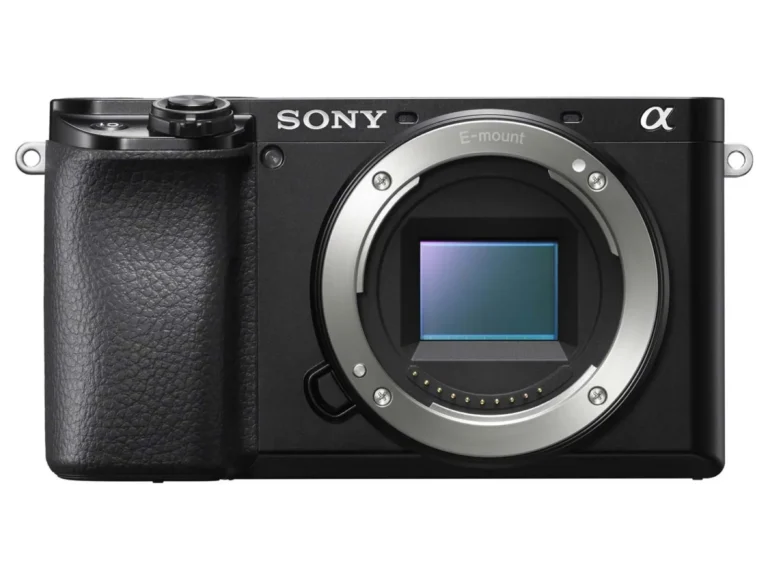
Sony a6100 (2019) is Sony’s modern entry-level APS-C camera. It has a 24 MP sensor, it offers excellent autofocus performance, can shoot at 11 fps with the mechanical shutter and it can record oversampled 4K video at 25 fps and at 30 fps with a 1.2x crop. Video recording is limited to 8-bit and the maximum clip length is set to 13 hours. The a6100 does not have a weather-sealed body.
Sony a6400 (2019) is Sony’s mid-range APS-C camera also featuring the same 24 MP sensor. Most specifications are similar to the a6100, but the a6400 uses a weather-sealed body and doesn’t apply a crop in 4K 30 fps recording. Video recording is still limited to 8-bit, but the a6400 includes Sony’s higher-quality S-Log 2 and S-Log 3 picture profiles.
Sony a6700 (2023) is Sony’s most advanced APS-C model featuring a new 26 MP BSI sensor paired with Sony’s BIONZ XR processor and Sony’s AI processing unit. It features several notable upgrades like a fully articulating screen and an even more advanced AF system with an AI-based deep-learning engine for enhanced subject recognition and tracking. It offers continuous shooting at up to 11 fps, it can record 4K video at 120 fps and oversampled 4K video at up to 60 fps in 10-bit. It has IBIS and a weather sealed body.
Canon EOS R10 Price
Final Verdict
Canon EOS R10 is Canon’s mid-range APS-C model. It offers a solid set of features for the price, with its most notable specifications being oversampled 4K video recording and continuous shooting speeds of up to 15 fps or 23 fps with the electronic shutter.
If you are not already invested in the Canon EOS R System, it is definitely worth considering alternatives from other brands. Depending on your priorities, competing cameras may offer features that the R10 lacks, such as weather sealing, in-body image stabilization, more advanced video recording options, or a wider selection of APS-C lenses.